How to Sleep With Hair Extensions (and After Keratin)

Yes, you can sleep with hair extensions, but only the right type and only with the right routine. Installed extensions (tape-ins, keratin bonds, micro rings, sewn-in wefts) are made to stay in overnight, provided they are completely dry, gently detangled and held in a loose braid or low ponytail. Clip-ins and other removable pieces come out before bed, every night. If you have just had keratin smoothing, the rules change again: loose hair, sleeping on your back and no accessories for the first days.
This guide covers all three situations, with the Dubai climate in mind, because air conditioning at night and sweat by day both affect how your hair behaves on the pillow.
TL;DR
- Installed extensions (tape-in, keratin bond, micro ring, sewn-in weft) can stay in overnight. Clip-ins, halos and clip-on ponytails should be taken out.
- Never go to bed with wet or damp extensions. Dry the roots, the scalp and every attachment point first.
- Brush gently from the ends upwards, then secure everything in a loose braid or low ponytail with a silk or satin tie. Use a silk or satin pillowcase.
- Pain, headaches or a pulling feeling mean the style is too tight. Tell your stylist.
- After keratin, follow your stylist’s instructions. Typically that means loose hair, no ties or clips, and sleeping on your back for the first 48 to 72 hours.
Table of Contents
- Is it okay to sleep with hair extensions?
- A bedtime routine for installed extensions
- What changes by extension type
- What happens if you sleep with wet extensions?
- Sleeping in Dubai: heat, air conditioning and sweat
- How to sleep after a keratin treatment
- What if you have extensions and keratin?
- Mistakes that cause morning knots
- Our perspective
- Book your extensions or keratin in Deira
- Looking after extensions between visits
- FAQ
- Sources
Is it okay to sleep with hair extensions?
It depends on how they are attached. The distinction is simple:
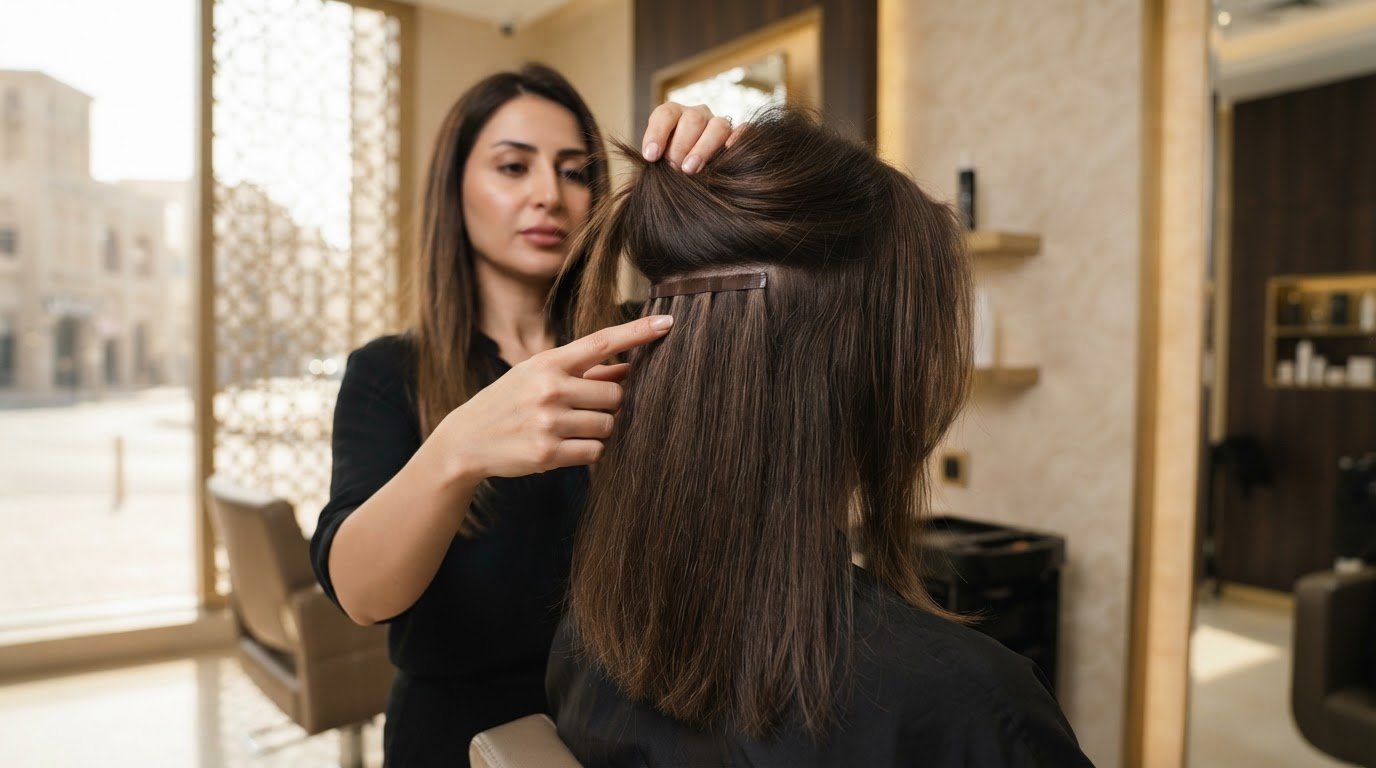
- Fixed (installed) extensions are applied by a stylist and worn continuously for weeks. Sleeping in them is expected. Tape-ins, keratin or K-tip bonds, micro and nano rings, and sewn-in wefts all belong here.
- Removable extensions are put in and taken out by you. Clip-ins, halos and temporary ponytail pieces fall into this group. Sleeping in them puts tension on the clips and on your own roots, and the hair tends to tangle and mat overnight. Take them out before bed and store them neatly.
If you are not sure which one you have, the instructions from your stylist or the extension maker always take priority over general advice. If you are still choosing a method, our guide to human hair extension types explains how each one is worn and cared for, and our comparison of nano rings and tape extensions helps if you are deciding between two of the most popular options in Dubai.
A bedtime routine for installed extensions
The routine takes about five minutes. Done every night, it is the cheapest way to keep your extensions looking good until your next maintenance visit.
1. Make sure everything is completely dry
This is the rule that matters most. Dry the hair, but also the scalp, the roots and the attachment points: tape tabs, bonds, beads or the weft line. Damp attachments are where matting starts, and trapped moisture against the scalp is uncomfortable and can irritate the skin.
If you wash your hair in the evening, use a hairdryer on a cool or medium setting and finish at the roots, where moisture hides longest. Aim the airflow along the hair rather than into the bonds. A light, hair-safe mist is fine for freshness, but avoid heavy oils or conditioner near the attachments, because they can loosen tape and bonds. If you like a scent in your hair, a hair mist rather than perfume is the gentler choice, and it should be kept to the lengths, away from the roots and attachment points.

2. Detangle gently, from the ends up
Use a soft brush made for extensions. Hold the hair just below the attachment with one hand so the brush never tugs at the bonds, start at the ends and work upwards in small sections. Ten seconds of careful brushing at night saves minutes of knots in the morning.

3. Secure the hair loosely
A loose braid is the classic answer, and for good reason: it keeps the lengths together and stops them whipping around on the pillow. A low, loose ponytail works too. Some points to get right:
- Use a silk or satin tie, or a soft scrunchie, never a tight elastic band.
- Keep the braid or ponytail low, away from the attachments at the crown and nape.
- Leave it loose enough that you can slide a finger under it.
- If a single braid bunches up at the ends, try two loose braids, or a loose braid secured with a soft tie further down.
A side effect many people like: a loose braid can leave soft, heatless waves in the morning.
4. Reduce friction on the pillow
A silk or satin pillowcase, or a silk bonnet or scarf, lets the hair glide instead of rubbing. This helps against tangling at the ends, which is where extensions suffer most. If you share a bed or move a lot, a bonnet is the more reliable option. Make sure it is not tight around the hairline.
5. Check how it feels
Extensions should never hurt. According to the American Academy of Dermatology, a style that causes pain, headaches or a pulling sensation is too tight and can lead to permanent hair loss through traction alopecia. If you wake up with a sore scalp, or the hairline feels tender, loosen your night style and book a check with your stylist. Our guide to avoiding traction alopecia with different extension methods explains which methods put the least strain on the roots.
What changes by extension type
The routine above works for every installed method. Each one has one detail worth knowing.
| Extension type | Overnight? | What to watch at bedtime |
|---|---|---|
| Tape-in | Yes | Keep the tabs dry and free of oils or heavy conditioner, and avoid a tight ponytail that drags on them |
| Keratin bond (K-tip) | Yes | Keep the bonds dry and avoid conditioner near them |
| Micro or nano ring | Yes | Check the beads cannot catch or pull on a pillow, a bonnet or your braid |
| Sewn-in weft | Yes | Dry the weft line completely and the scalp beneath it |
| Clip-in, halo, clip-on ponytail | No, take out | Remove before bed to avoid tension, breakage and matting |
If you wear micro beads, our micro bead extension care guide for Deira covers the nightly and weekly checks in more detail. For bonded extensions, the K-tip consultation guide explains what to expect from a fitting.
What happens if you sleep with wet extensions?
Wet hair is at its weakest, and wet extensions are worse. Damp hair tangles more easily, which creates knots at the bonds and can loosen the extensions. Moisture that stays trapped at the attachment points can also lead to matting and, over time, to a damp, irritated scalp. Extension specialists consistently advise the same thing: dry fully before bed.
If you have no time to dry properly, a practical fallback is to wash your hair earlier in the evening, or to wash it in the morning instead. And if you are caught in a late-night swim or a sweaty workout, our post-swim checklist for extensions shows how to rinse, dry and check everything in about ten minutes.
Sleeping in Dubai: heat, air conditioning and sweat
Two local habits can make a difference. First, many of us sleep in strong air conditioning, which dries hair out. A light leave-in product on the mid-lengths and ends (not near the bonds) keeps extensions soft. Second, summer nights can be warm and sticky, and sweat soaking into a tight bun or a thick braid is what causes morning knots. Keep the style loose and low, and if you wake up damp, let the hair dry fully before you go back to sleep, rather than leaving it tied up.
How to sleep after a keratin treatment
Keratin smoothing has its own rules, because the treatment needs time to settle into the hair. The exact length depends on the product and your salon, so always follow your stylist’s instructions first. As a general pattern, salons in the UAE commonly ask clients for the first 48 to 72 hours to:
- Keep the hair loose: no ties, clips, bobby pins or tucking behind the ears, because any bend can leave a crease.
- Skip scrunchies, sleep caps and bonnets during this initial window.
- Sleep on your back, using an extra pillow on either side if you tend to roll over, so the hair does not fold under your head.
- Avoid sweat, steam and humidity. In the Dubai summer, that means staying in air conditioning as much as you can and skipping outdoor workouts for the first days.
- Avoid washing until your stylist gives the go-ahead.
If you wake up with hair that is slightly damp from sweat, dry it gently with a hairdryer on a medium heat setting rather than high heat. Once the waiting period is over, a silk or satin pillowcase and a loose braid keep the smoothness for longer. You can see the treatment details on our keratin, protein and botox smoothing package page.
What if you have extensions and keratin?
This is common, because smooth hair blends more easily with extensions. The order matters: plan the keratin and the extension fitting with your stylist, so that bonds and tapes are not exposed to products that can loosen them. Ask which should come first, and ask for the aftercare for both in writing. Colour is part of the same planning, and our notes on matching and blending extensions explain why the colour is best matched in the salon, and how balayage with extensions can be done by the same stylist for a seamless result.
Mistakes that cause morning knots
- Sleeping with hair down. The lengths rub the pillow all night and mat at the ends.
- A tight bun or high ponytail. It pulls on the attachments and your own roots.
- Going to bed with damp roots. It is the most common cause of matting at the bonds.
- Cotton pillowcases and rough scarves. They create friction. Silk or satin is gentler.
- Skipping the brush. Tangles left overnight turn into knots by morning.
- Ignoring discomfort. A tight or painful feeling is a reason to loosen the style and see your stylist, never to wait it out.
Our perspective
Most of the extension problems we see in Deira do not start in the salon chair. They start on the pillow, with damp roots, a tight bun or a missing brush. That is why every fixed-price package we offer comes with a consultation and home-care guidance, so you leave knowing exactly what to do at bedtime for the method we chose for you.
We plan colour and extension type together, and we explain the nightly routine in plain words: dry, detangle, loosen, protect. We also back our work with a 10-day satisfaction guarantee, and you pay after the service is completed. Our view is simple: extensions that are fitted well and cared for for five minutes a night look better, last longer and feel comfortable.
Boost
Book your extensions or keratin in Deira
If you are planning extensions or smoothing and want a stylist to explain the aftercare in person, we can help. Our Hair Extension Package is AED 1,499 with colour matching and blending, and our Keratin/Protein/Botox Package is AED 1,299, both fixed-price and priced the same for any hair length, with payment after the service.

We are one minute from Salah Al Din Metro Exit 1. See the Hair Extension Package or the keratin package, or book through WhatsApp or by phone from the salon page in Deira.
Looking after extensions between visits
A good night routine is one half of the job. The other is regular maintenance. Fixed extensions need a check every 6 to 8 weeks, so the stylist can look at the scalp, move or reapply bonds and tapes, and catch tangling early. Our extension maintenance guide explains what happens at those appointments and how to protect scalp health in between. If you are still looking for someone to fit them, our article on what to look for in an extension specialist in Dubai clears up common myths.
FAQ
Is it okay to sleep with hair extensions?
Yes, if they are installed extensions such as tape-ins, keratin bonds, micro rings or sewn-in wefts, and they are dry and loosely secured. Clip-in extensions, halos and clip-on ponytails should be removed every night. When in doubt, follow your stylist’s instructions.
How should you sleep when you have extensions?
Brush them gently from the ends up, then tie them in a loose braid or low ponytail with a silk or satin tie. Sleep on a silk or satin pillowcase, or wear a silk bonnet. Keep the style loose enough that it never pulls on your scalp.
What happens if I go to bed with wet extensions?
Wet extensions tangle and mat much more easily, and can loosen at the bonds or tapes. Moisture trapped near the scalp can also cause irritation. Always dry the roots and attachment points completely before bed.
How do I sleep after a keratin treatment?
Follow your salon’s instructions, which usually mean keeping your hair loose and untied for the first 48 to 72 hours. Sleep on your back, avoid clips, scrunchies and caps, and stay out of sweat, steam and humidity. If your hair gets damp from sweat, dry it on a medium heat setting.
Sources
- How to prevent hair damage from a weave or extensions, American Academy of Dermatology
- Can you spray perfume on hair? So…? Fragrance
Recommended
Ready to book this look?
See this package