Hijab Hair Care: A Simple Routine for Healthy Hair

Healthy hair under a hijab comes down to four habits: dry your hair fully before covering it, tie it loosely and change the spot, wear breathable fabrics, and wash the scalp on a steady schedule. Salon treatments such as colour, keratin smoothing, curl definition and extensions fit into this routine when they are planned around how you cover. At Boost Beauty Lounge in Deira, we plan every package after a consultation, so the treatment suits how you wear your hijab.
TL;DR
- Never cover damp hair. Trapped moisture under fabric encourages dandruff and fungus.
- Choose natural, breathable fabrics (cotton, linen, silk) and wash scarves and undercaps often.
- Keep styles low and loose, and change the parting and tie position so one spot is not pulled every day.
- Give your scalp uncovered time at home, and massage it gently.
- See a doctor if you notice broken hairs, a receding hairline or thin or bald patches.
Table of Contents
- What a hijab changes for your hair and scalp
- Wash and dry: the base of the routine
- Fabrics and undercaps
- Hairstyles that protect the hairline
- Between wash days
- Colour, smoothing, curls and extensions under a hijab
- When to see a doctor
- Our hair packages in Deira
- Our view on hijab hair care
- FAQ
- Sources
What a hijab changes for your hair and scalp
A hijab does not damage hair by itself. The problems come from three things: heat and moisture trapped against the scalp, friction from the fabric, and tension from tight styles.
In a hot city like Dubai, the first one matters most. Covering the head for hours holds sweat and warmth against the scalp. CNA Lifestyle advises people in humid climates to wash headgear often, because it collects sweat, oil and bacteria, and to let the scalp breathe whenever it feels hot, itchy or greasy.
Vogue Arabia reports a trichology practitioner’s view that long hours of covering can limit airflow to the scalp. Her suggested counter is a daily scalp massage with the fingers or a Gua Sha comb, in circular motions.
Friction and tension are the second and third causes. A review of religious headwear and hair loss in a peer-reviewed journal notes that chronic traction can lead to hair loss that may not grow back. That is why the style you choose under the scarf matters as much as the shampoo you use.

The good news is that the fixes are simple and cost very little. The sections below take them in the order you would use them in a normal week.
Wash and dry: the base of the routine
How often to wash
There is no single number. Oily scalps need more frequent washing and dry or curly hair needs less. A useful starting point for most people is two to three washes a week, with an extra wash after heavy sweating or on very hot days. The same applies in summer in the UAE, when you sweat more under the scarf. In cooler months you can often wash a little less.
A few rules make each wash count:
- Shampoo the scalp with your fingertips, not your nails. The lather rinsing down the lengths is enough to clean them.
- Rinse completely. Leftover product near the roots is a common cause of itch.
- Apply conditioner to the mid-lengths and ends, not the roots.
- Use a deep conditioning mask weekly if your ends feel dry.
If your hair is wavy or curly, a wavy hair wash day routine gives a clear step-by-step order for shampoo, conditioner and styling that fits the same logic.
Dry fully before you cover
This is the single most repeated piece of advice in the sources. MOJEH reports an expert’s advice never to cover wet hair, because a damp scalp can develop dandruff or fungus. Vogue Arabia says the same, noting that chronic moisture on the scalp is an ideal breeding ground for both.
In practice:
- Press the water out with a soft towel rather than rubbing.
- Dry the roots first, with cool or lukewarm air if you use a dryer.
- Check by touch. The roots are the last part to dry, and a bun hides damp hair.
- If you are short of time, wash in the evening and let the hair dry overnight.
A wet bun under a scarf is the most common mistake. If you are rushing in the morning, wear the hair down or loose until it is dry, then cover.
Wash scarves and undercaps too
Your hair can be clean while the cloth against it is not. Wash undercaps and scarves weekly, or more often in summer. MOJEH reports advice to change and wash both the underscarf and the scarf very often, to prevent clogged pores and breakouts along the hairline. Keep a few clean undercaps in rotation so you are never wearing yesterday’s.

Fabrics and undercaps
Breathable fabrics let heat and moisture escape. Vogue Arabia recommends natural fibres such as cotton, silk and linen for the hijab, with undercaps in bamboo or cotton, and advises avoiding polyester and tight undercaps. CNA Lifestyle gives the same guidance for humid climates, and adds mesh and moisture-wicking fabrics as options.
The fit of the undercap matters as much as the fabric. The dermatology review linked above recommends undercaps that tie at the back or can be adjusted rather than one-size tube caps, and says jersey or cotton are less likely to slip. A cap that slips makes you tug the scarf back into place, which adds friction at the hairline.
A simple way to choose:
| Item | What to look for | What to avoid |
|---|---|---|
| Hijab | Cotton, linen, silk | Polyester, nylon |
| Undercap | Cotton or bamboo, adjustable or tie-back | Tight, one-size tube caps |
| Hair tie | Soft, wide, snag-free | Thin elastics with metal parts |
If your hair is dry or curly and you find cotton rubs it, a satin-lined undercap under a cotton hijab is a sensible option. Hyphen reports a haircare expert advising this to cut friction and hold in moisture.
Hairstyles that protect the hairline
Traction alopecia is hair loss caused by constant pulling on the follicles. It shows up first around the hairline and temples. MOJEH quotes a Dubai hair professional who calls it the most common issue she sees in hijab-wearing clients, and who recommends a low bun or a looser ponytail to protect the delicate roots at the front.
A few habits reduce the risk:
- Keep the style low and loose: a low bun, a loose braid or a soft twist.
- Change the parting and the bun position. The review above advises varying where any knot or ponytail sits.
- Avoid a tight, slicked-back style every day.
- Use soft, wide ties rather than thin elastics.
- Do not wrap pins or bands tightly. Move pin positions every few days.
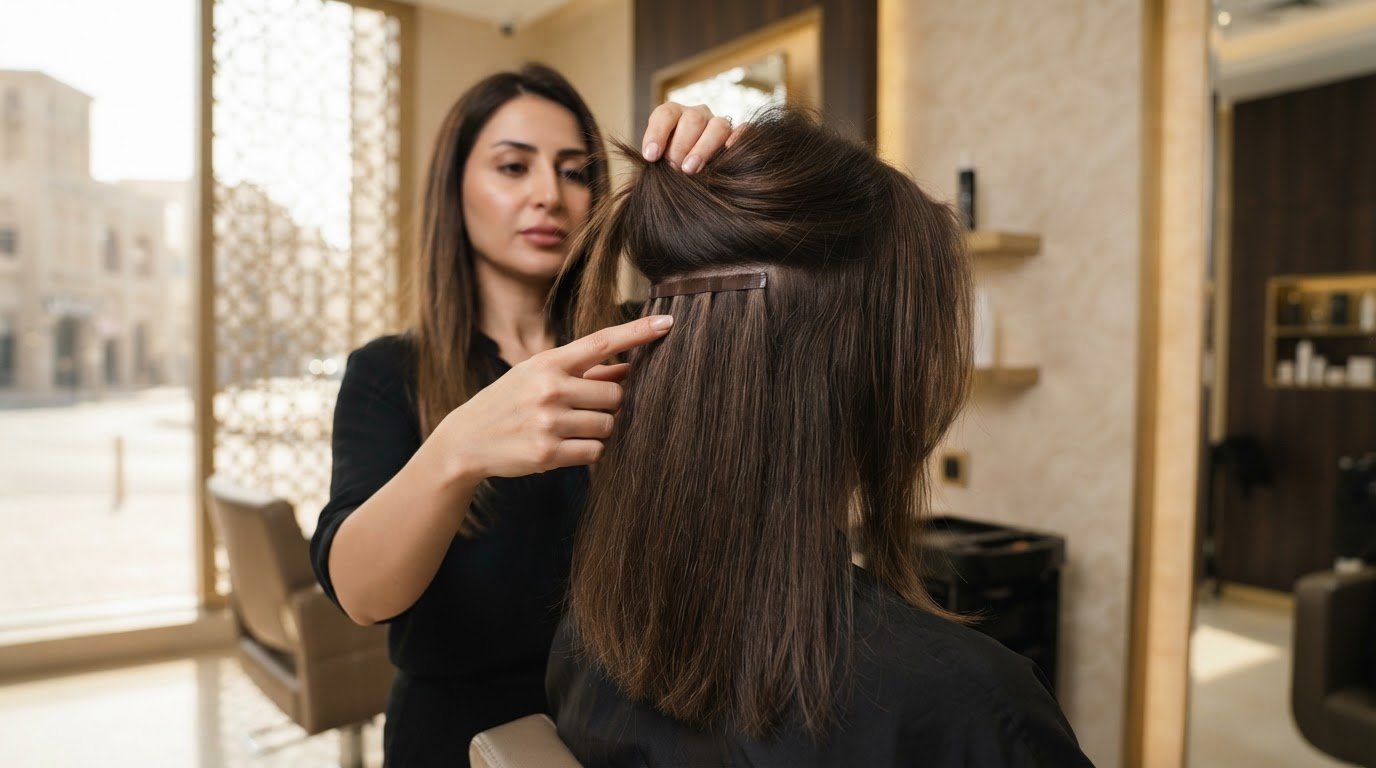
If you wear extensions, the method matters because it decides where the weight and tension sit on your hair. Our guide to hair extension methods and traction alopecia explains the options, and the extensions maintenance guide covers why regular checks every 6 to 8 weeks protect the scalp.
Between wash days
Most of hair care under a hijab happens on the days you do not wash. Keep it short and regular.
Before you cover (about five minutes). Check the roots are dry. Smooth one or two drops of a light oil through the ends only, not the scalp. If you use a leave-in conditioner, apply a small amount to the lengths, not the roots.
During the day. Lift or loosen the scarf briefly if you feel heat, itch or pulling. If you have been sweating, let the roots dry before you re-cover.
At home. Take the scarf off and let the scalp breathe. A Dubai-based clinical writer on scalp care suggests that 30 to 60 minutes a day of uncovered hair makes a noticeable difference. Use this time for a scalp massage with your fingertips, in circles.
Once a week. Exfoliate the scalp gently to remove product build-up. Vogue Arabia suggests weekly or every two weeks. Deep condition the ends. Clean your hairbrush.
Every few months. Trim the ends to remove splits before they travel up the hair.
Do not assume itch means dry
Itch under a hijab is not always dryness. It can come from sweat, product build-up, an undercap seam or a fragranced product. If your scalp itches, look for the cause before adding more products or washing more. Often a better rinse and lighter products near the roots help more than a new treatment.
Dubai water and humidity
Two local factors affect your routine. Dubai’s humidity makes frizz worse once you take the scarf off, and mineral-rich tap water can leave a film on hair. Our guides on preventing frizz outdoors in Dubai and hair treatment for hard water damage cover both. For the wider routine, see women’s hair care in Dubai.
Colour, smoothing, curls and extensions under a hijab
Many women who cover still want their hair to look good when it is uncovered: at home, with family, at women-only gatherings or at the salon. A hijab routine and salon treatments work together, and a few points help you choose.
Colour. Balayage, highlights, ombre and full colour are done in the salon, with the hair then toned, conditioned and styled. Soft, lived-in colour such as balayage grows out gently, so you are not tied to frequent root visits. That suits a routine where the hair is covered most of the day.
Keratin, protein or botox smoothing. Smoother hair is easier to detangle and to tie loosely under the scarf. After a smoothing treatment, follow your stylist’s timing for the first wash. We explain it in when to wash hair after keratin, and in hair botox vs keratin. For thick hair, see the guide to smoothing treatment for thick Arab hair.
Curl definition. Curly hair needs moisture and a gentle hand under a hijab. A curl treatment gives you a defined base to refresh between washes, and our curly hair routine for humid weather in Dubai shows how to keep it.
Deep conditioning. Covering and Dubai’s air-conditioning both dry out the ends. A salon deep conditioning step restores them. Here is our deep conditioning step-by-step guide.
Extensions. Extensions add length and volume, with colour matching and blending to your own hair. Choose a method that does not pull at the hairline, and keep up the regular checks.
Whichever you choose, tell your stylist how you cover: how many hours a day, where you place your bun, and which undercap you wear. That information shapes the plan.
When to see a doctor
Care at home handles most itch, dryness and dandruff. Some signs need a professional. Health.com advises calling a healthcare provider or dermatologist if you see broken hairs, a hairline that is pulling back, or bald or thin patches. They can check for a fungal or bacterial problem and look at other causes of hair loss.
See a doctor or dermatologist too if the itch is severe, if flaking does not settle with a gentle routine, or if shedding continues for weeks. Because covering reduces sun exposure, it is also reasonable to ask your doctor about a vitamin D and ferritin blood test if you are losing hair.
Our hair packages in Deira
If you want colour, smoothing, curls or extensions planned around your routine, we offer fixed-price packages at Boost Beauty Lounge, the same price for any hair length. Each starts with a consultation, you pay after the service, and we give home-care guidance and a 10-day satisfaction guarantee.

- The Hair Package is AED 1499 and covers balayage, highlights, ombre or full colour, with roots touch-up, toning, haircut, deep conditioning, blow-dry and styling.
- The Keratin/Protein/Botox Package is AED 1299.
- The Curl Package is AED 999.
- The Hair Extension Package is AED 1499.
The salon is one minute from Salah Al Din Metro Exit 1. Book through WhatsApp or by phone from the website.
Our view on hijab hair care
Most hair problems under a hijab are routine problems, not hair problems. Damp roots, tight styles and unwashed fabric do more harm than the scarf.
We plan each package around the consultation. We ask how you cover, how long, and what your hair does under the scarf. A colour, a smoothing treatment or a curl service works best when it is planned for that daily reality.
We keep prices fixed for any hair length and take payment after the service, so the plan is clear before you sit down. We also give home-care guidance, so the result lasts between visits.
Boost
FAQ
How often should I wash my hair if I wear a hijab?
Two to three times a week suits most people, with an extra wash after heavy sweating. Curly or dry hair can go longer between washes, and oily scalps may need more. Always dry the roots fully before covering.
Can wearing a hijab cause hair loss?
The hijab itself is not the cause. Tight styles that pull on the hairline, trapped moisture and dirty fabric can lead to breakage or traction hair loss. Keep styles loose, change the tie position and see a doctor if you notice thin patches.
What is the best undercap for hair health?
Choose a soft, breathable cap in cotton or bamboo that is adjustable or ties at the back. Avoid tight caps and polyester. If your hair is dry or curly, a satin-lined cap can reduce friction. Keep several clean caps in rotation.
Is it safe to do hair colour or keratin if I wear a hijab?
Yes, with a plan. Tell your stylist how you cover, and follow the aftercare, including the timing of the first wash after smoothing. Keep drying the roots fully before you cover.
Sources
- CNA Lifestyle: hats, helmets and hijabs and scalp health
- Vogue Arabia: a guide to hair care for hijabis
- MOJEH: how wearing a hijab can impact skin and hair health
- PMC: religious headwear and alopecia
- Hyphen: how to maintain healthy hair underneath your hijab
- Pharmacia1: scalp care routine for hijab wearers
- Health.com: can wearing a hat cause hair loss
- Purple Mango Beauty: wavy hair routine
Recommended
Ready to book this look?
See this package