Avoid Traction Alopecia: 7 Hair Extension Methods in Dubai

Hair extensions fall into three broad families: temporary (clip-ins, halo), semi-permanent (tape-ins, micro and nano rings), and long-wear (sew-in wefts, fusion or keratin bonds), with wigs and toppers serving hair loss or coverage needs separately. Clip-ins suit occasional event use, tape-ins suit fine hair needing low-tension volume, and fusion suits those wanting months of seamless length. Each method carries a different damage profile, so the right choice depends as much on your scalp as your style goals.
TL;DR:
- Remy human hair extends its lifespan and maintains natural appearance better in humid environments, making it a cost-effective choice for such climates.
- Fine or fragile hair benefits most from tape-ins, nano rings, or halos, while thicker, coarser hair is better suited for sew-ins or keratin bonds.
- Regularly scheduled hair breaks and gentle scalp care reduce traction alopecia risk across extensions involving tension or weight.
- Maintenance appointments are required every six to eight weeks for tape-ins and rings, with longer cycles for sew-ins and bonds, influencing overall long-term costs.
- Proper consultation ensures method suitability for your density, scalp health, and lifestyle, minimizing damage and ensuring extensions last as long as expected.
Table of Contents
- 1. Quick types overview: what each method actually is
- 2. Human hair vs synthetic: materials, styling and climate considerations
- 3. Detailed breakdown of the main methods: pros, cons and lifespan
- 4. How to choose the right extension type for your hair and goals
- 5. Risks and scalp health: what causes damage and how to prevent it
- 6. Care and maintenance: daily routine and product choices
- 7. Cost and longevity expectations: budgeting for the long term
- 8. A salon’s perspective on responsible extension use
- 9. Our extension package: what it includes and how to book
- FAQ
- Sources
1. Quick types overview: what each method actually is
Before weighing costs or maintenance, it helps to know what you are choosing between. The methods below sit on a spectrum from fully removable to semi-permanent and long-wear.
- Clip-ins: wefts attached to small clips you snap into your own hair; fully temporary, removable in minutes, suited to occasional wear and all hair textures.
- Halo extensions: a single wire-based weft that sits on the crown under your natural hair; no clips or bonds, ideal for people who want volume without any attachment to the scalp.
- Tape-ins: thin wefts with adhesive strips sandwiched around sections of natural hair; semi-permanent, typically reapplied every six to eight weeks, well suited to fine or thinning hair because the weight is distributed flat against the scalp.
- Sew-in or weft extensions: wefts braided into cornrows and sewn onto the braid; longer-wearing, better suited to thicker or coarser hair that can support the braid’s tension.
- Fusion or keratin bonds: individual strands fused to small sections of natural hair using a heated keratin polymer; long-lasting and discreet, but application takes hours and removal requires a solvent.
- Micro and nano rings: small metal rings clamp extension strands to your own hair without heat or adhesive; a mechanical, heat-free alternative to bonds, with nano rings being the finer, less conspicuous version.
- Wigs and toppers: full or partial hairpieces worn over your own hair or scalp, often chosen for hair loss, thinning crowns, or total styling flexibility rather than length alone.
Permanence runs from clip-ins and halos (hours), to tape-ins and rings (weeks between salon visits), to sew-ins and fusion (months before reapplication is needed). Texture matters too: fine hair generally tolerates tape-ins and nano rings better than heavier sew-ins or thick fusion bonds, which can overload finer strands.
2. Human hair vs synthetic: materials, styling and climate considerations
The material behind any extension method matters as much as the attachment style. Remy human hair keeps its outer cuticle layer intact and aligned in one direction, so it resists tangling and takes heat styling, colour and washing much like your own hair. Non-Remy or blended human hair has had its cuticle stripped or realigned during processing, which shortens its usable life and makes it prone to matting. Synthetic hair is the most affordable option but cannot tolerate styling tools above low heat settings and tends to look less natural under bright light.
- Remy human hair: cuticle intact, takes heat and dye, longest-lasting of the three categories.
- Non-Remy or blended human hair: more affordable than Remy, but tangles faster and has a shorter usable life.
- Synthetic hair: lowest cost, fixed colour and texture, limited or no heat tolerance.
Climate plays a bigger role than most people expect. In hot, humid conditions, lower-quality synthetic or mixed hair tends to frizz and tangle faster, and oily or sweaty scalps can cause bonds to slip sooner; Remy human hair with its cuticle intact resists this far better, which is one reason it performs more reliably in humid environments.
Investing in Remy human hair with intact cuticles noticeably reduces tangling and bond slippage in humid climates, according to industry reporting on humidity’s effect on extension quality.
When buying or booking, ask whether the hair is 100% Remy, check that the vendor can explain its sourcing, and avoid anything described only as “human hair blend” without further detail, since that phrasing often masks a mix with synthetic fibre.
3. Detailed breakdown of the main methods: pros, cons and lifespan
Each method trades off application time, cost, maintenance and risk differently. Here is how the main options compare in practice.
-
Clip-ins: applied and removed by hand in under ten minutes, no ongoing maintenance between wears, and the lowest damage risk of any method since nothing is attached to the scalp overnight. They suit anyone wanting occasional length or volume for events, but they are visible under very short or fine hair unless sectioned carefully. Pro Tip: Match the weft colour to your roots rather than your ends, since clip-ins sit closest to the root line.
-
Halo extensions: worn over the crown and hidden by a thin layer of your own hair, halos need no clips or bonds and come off in seconds. They are the gentlest semi-temporary option for anyone nervous about attachment damage, though they rely on having enough natural hair on top to disguise the wire.
-
Tape-ins: application takes around 45 minutes to an hour, with semi-permanent wear before the tapes need shifting up as hair grows. The flat adhesive strips distribute weight evenly, making tape-ins a frequent recommendation for fine or fragile hair, though sustained adhesive contact does impose occlusion stress on the scalp over time. Pro Tip: Keep oil-based products away from the first two centimetres of hair near the root, since oil breaks down tape adhesive faster.
-
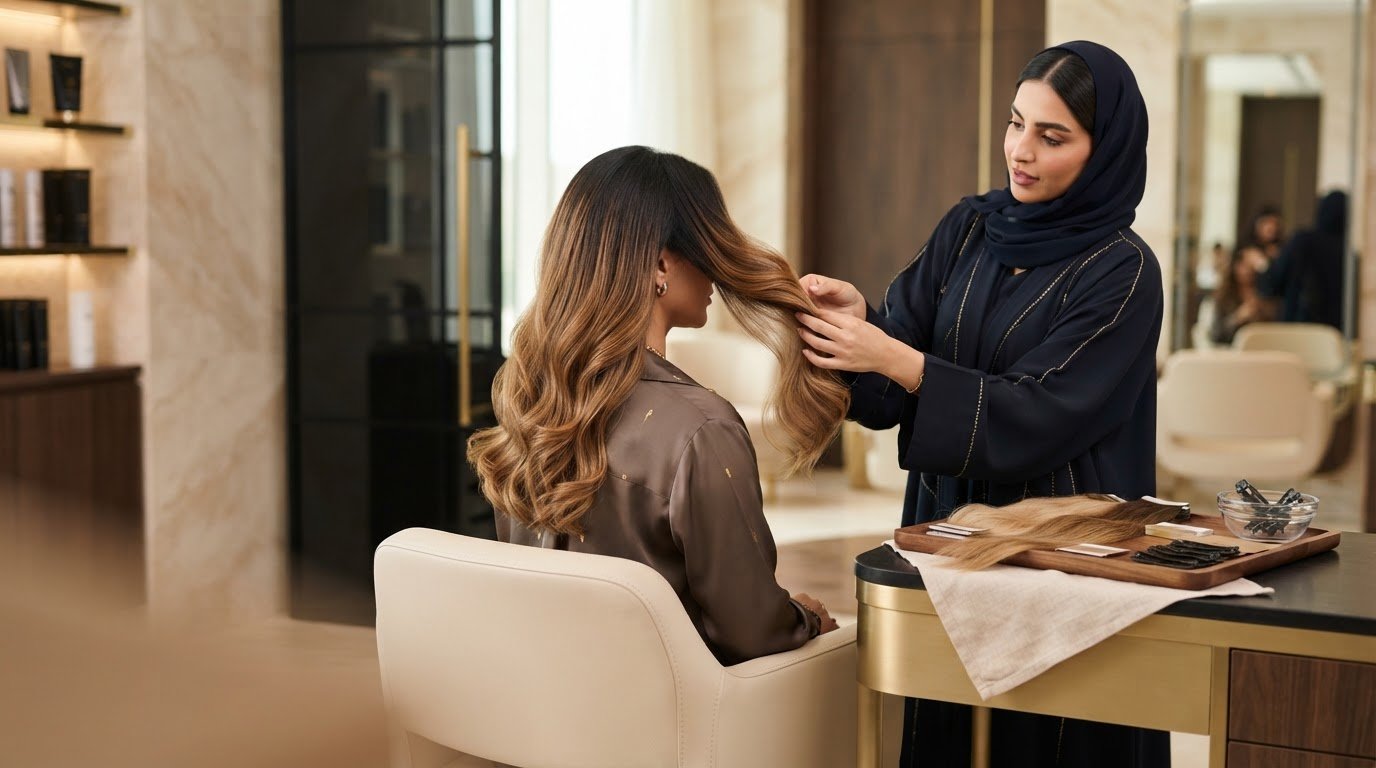
Sew-in or weft extensions: cornrows are braided across the scalp and wefts are sewn onto them, a process that can take two to three hours. Sew-ins last several weeks to months and suit thicker, coarser hair that can tolerate the braid’s tension, but traction is transmitted linearly along the braid track, concentrating load where the weft is anchored.
-
Fusion or keratin bonds: individual strands are fused to small sections of hair using a heated keratin polymer, an application process that commonly runs three to five hours for a full head. Bonds can last several months and blend almost invisibly, but the heated bonding capsule concentrates load and adds thermal stress at a single point on the strand, so fusion is generally better suited to thicker, healthier hair than to fine or already-stressed strands. Pro Tip: Ask your stylist to stagger bond placement in a brick pattern rather than a straight row, which spreads tension more evenly across the scalp.
-
Micro and nano rings: small metal rings clamp sections of extension hair to natural hair without heat or adhesive, taking roughly two to three hours to apply. Rings create focal compression at each attachment point rather than the linear traction of a sew-in or the single-point heat stress of a bond. Nano rings, being finer, tend to be gentler on fine hair than standard micro rings or thick fusion bonds, provided a stylist limits the weight placed on each strand, as industry guidance on modern extension methods notes.
-
Wigs and toppers: worn over the scalp rather than attached to individual strands, these carry no traction risk to existing hair and suit anyone managing thinning or hair loss. They need no salon reapplication cycle, though fit and ventilation affect comfort over long wear.
From a stylist’s chair, the choice usually comes down to how much tension the client’s hair and scalp can realistically carry, not just how long they want the extensions to last.
4. How to choose the right extension type for your hair and goals
Picking a method starts with an honest look at your own hair, not just the style you want to copy. A short readiness check before booking saves both money and regrowth stress later.
- Density check: thin or fine hair carries weight less well, favouring tape-ins, nano rings or halos over heavy sew-ins or fusion.
- Scalp condition: any redness, flaking or recent hair loss should be addressed before adding any attached method.
- Lifestyle fit: frequent swimmers or gym-goers may find tape-ins or rings easier to maintain than bonds that need protecting from heat and friction.
- Heat and styling habits: regular straightening or curling favours Remy human hair over synthetic, regardless of attachment method.
- Budget and time: factor in both the upfront cost and the recurring maintenance appointment every six to eight weeks.
Ask any stylist these questions before booking: which method do you recommend for my density and scalp, what is the realistic lifespan before reapplication, what does removal involve, and what aftercare products should I use at home. A stylist who cannot answer clearly, or who pushes a single method regardless of your hair, is a reasonable reason to seek a second opinion.
| Consideration | What to check |
|---|---|
| Density | Fine or thinning hair suits tape-ins, nano rings or halos over fusion or sew-ins |
| Scalp health | No active redness, flaking or recent shedding before attachment |
| Maintenance time | Six to eight week salon visits for tape-ins and rings; longer gaps for fusion and sew-ins |
| Removal plan | Ask how the method is removed and whether it requires a professional appointment |
5. Risks and scalp health: what causes damage and how to prevent it
Traction alopecia is the main risk tied to extensions, and it develops from repeated tension pulling on the hair follicle rather than from any single bad appointment. Dermatology reviews describe it as arising from sustained pulling force, commonly linked to tight hairstyles and extensions, with early signs including perifollicular redness and hairline recession.

Attachment method changes where and how that tension lands on the scalp, according to a review of extension biomechanics, which notes that frontal and temporal margins are especially vulnerable because the hair shafts there are thinner and the skin more mobile.
Mitigation is practical rather than complicated. Dermatology-aligned guidance recommends scheduled ‘hair breaks’, typically six to eight weeks wearing extensions followed by two to three weeks without, alongside patch testing for adhesive sensitivity and using low-pH cleansers to support the scalp barrier. Avoid applying any attached method to a scalp that is already irritated, and see a dermatologist promptly if you notice persistent redness, tenderness or a widening parting line, since early intervention improves outcomes.

6. Care and maintenance: daily routine and product choices
Good aftercare protects both the extensions and the natural hair underneath, and it starts with how you brush. Always brush from the ends upward, holding the section above the attachment point to avoid pulling on bonds, tapes or rings.
- Brushing: use a loop or extension-specific brush, working from ends to roots, two to three times a day to prevent matting.
- Washing: wash two to three times a week with a low-pH, sulphate-free cleanser, letting water run down rather than scrunching at the roots.
- Drying: air-dry when possible or blow-dry on a cool setting, keeping heat tools away from bonds, tapes and rings.
- Products to avoid near attachment points: heavy oils and silicone-based conditioners, which can loosen tape adhesive and soften keratin bonds.
In hot or humid conditions, tie hair loosely at night and avoid high-tension styles like tight ponytails, which add extra pull on top of normal wear.
Pro Tip: Store clip-ins and halos on a wig stand or hanging hook rather than folded in a drawer, which keeps the weft from creasing or tangling between wears.
7. Cost and longevity expectations: budgeting for the long term
Extensions are rarely a one-off purchase, and budgeting for the reapplication cycle matters as much as the first appointment. Temporary methods like clip-ins and halos involve a single upfront cost with no recurring salon visits, since you apply and remove them yourself. Semi-permanent methods such as tape-ins and rings typically need a maintenance visit every six to eight weeks to move the attachment point up as hair grows, while sew-ins and fusion bonds stretch that cycle to two or three months but involve a longer, more involved removal process.
- Clip-ins and halos: one upfront cost, no ongoing salon maintenance.
- Tape-ins and rings: reapplication roughly every six to eight weeks.
- Sew-ins and fusion: reapplication roughly every two to three months, with a dedicated removal appointment.
Higher-quality Remy human hair costs more initially but tends to need replacing less often than lower-grade blends, which can offset the price difference over a year of regular wear.
8. A salon’s perspective on responsible extension use
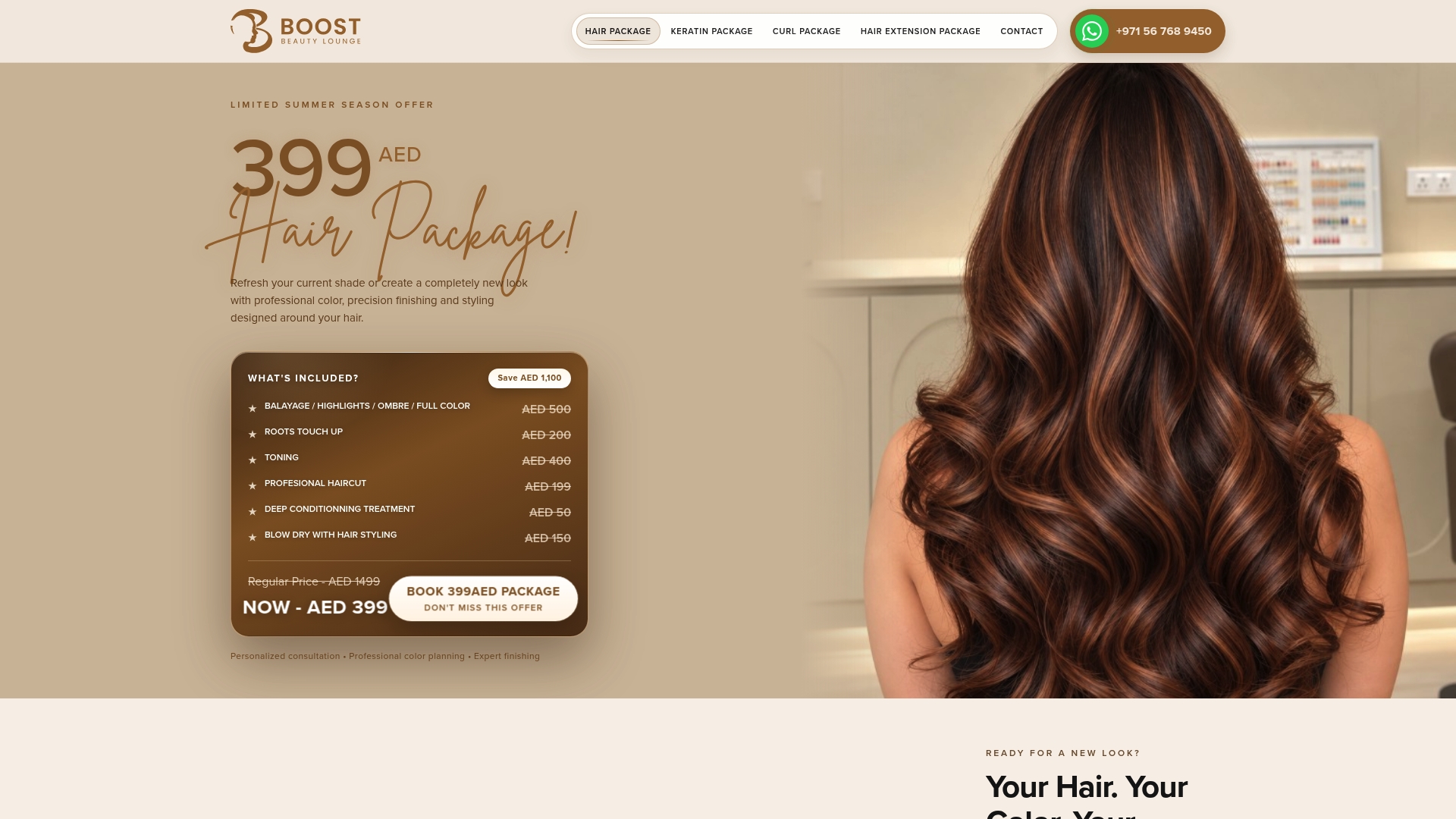
We approach every extension consultation the same way: assess density and scalp condition first, then match method and colour to what the hair can realistically support, never the other way round. Our Hair Extension Package includes that consultation, colour matching and blending, aftercare guidance, and a 10-day satisfaction guarantee, the same framework we apply to our AED 399 hair colour package. The most common mistake we see is clients choosing a method based on a photo rather than their own hair’s density, which is exactly the gap a proper consultation closes.
— Boost
9. Our extension package: what it includes and how to book
Choosing extensions without a consultation is a bit like buying shoes without trying them on: the method that looked perfect online may not suit your density, scalp or lifestyle at all. Our Hair Extension Package is built around that gap. It starts with an in-person assessment of your hair and scalp, then moves into colour matching and blending so the extensions sit seamlessly against your own hair, followed by aftercare advice tailored to the method you choose.
- Consultation-first planning: method and colour chosen after assessing your density and scalp, not before.
- Colour match and blend: extensions blended to your natural shade and cut for a seamless finish.
- Aftercare guidance: home-care instructions specific to the attachment method you leave with.
- 10-day satisfaction guarantee: reassurance built into every package, with payment only after the service is completed.
If you are searching for accessories to support thinning areas between salon visits, clip-style integration pieces can bridge the gap for finer sections. For the full in-salon service, book through WhatsApp or by phone, or get in touch through our extension package page to check availability near Salah Al Din Metro Exit 1.
FAQ
What type of hair extensions are best?
There is no single best type: tape-ins suit fine hair wanting low-tension volume, fusion or keratin bonds suit thicker hair wanting months of seamless length, and clip-ins suit anyone wanting a temporary, damage-free option for occasional wear. The right choice depends on your density, scalp health and how much maintenance you want to commit to.
What are the four types of hair extensions?
The four most commonly discussed categories are clip-ins, tape-ins, sew-in wefts, and fusion or keratin bonds, with micro and nano rings and halo extensions often added as further options. Industry coverage of modern extension methods groups these by attachment mechanism rather than by a fixed count of four.
What’s the healthiest type of hair extension?
Halo extensions and clip-ins carry the lowest risk since nothing is attached to the scalp overnight, making them the gentlest options for hair prone to breakage. Among semi-permanent methods, tape-ins and nano rings tend to distribute weight more evenly than thick fusion bonds or sew-ins, though all attachment methods carry some risk of traction if worn too tightly or too long without a break.
Which is the best hair extension method?
The best method is the one matched to your hair’s density and your scalp’s condition rather than a single universally superior option. A consultation that checks scalp health, hair density and lifestyle before recommending tape-ins, rings, sew-ins or fusion gives a far more reliable answer than style preference alone.
How much do hair extensions cost at a salon?
Costs vary by method, hair quality and region, so it is worth asking for a fixed quote during consultation rather than relying on a general figure. Our own Hair Extension Package is priced as published by the provider and includes consultation, colour matching, blending and aftercare guidance.
Sources
- Traction alopecia — StatPearls / NCBI Bookshelf
- Hair extensions: anatomic, biological and clinical — Journal of Craniofacial Surgery Open (Ovid abstract)
- Hair extensions, decoded: 9 types actually worth your investment — British Vogue
- Traction alopecia: is your hairstyle contributing to your hair loss? — Vivandi
Ready to book this look?
See this package