Extension-Friendly Hair Colour: What to Colour and When

The safest colour for hair extensions is a shade that matches your hair or goes slightly darker. Colour that lifts or lightens is the risky direction. Only extensions made from real human hair can take regular dye at all. The best plan is to choose the extension shade first and then colour your own hair around it, with one stylist who sees both together.
In Dubai, we do this at Boost Beauty Lounge in Deira, one minute from Salah Al Din Metro Exit 1. Our Hair Extension Package is AED 1,499 one-off and includes colour matching and blending.
TL;DR
- Only 100% human hair extensions can be dyed. Synthetic fibre should not be coloured with regular dye.
- Darkening by one to three shades, or toning, is low-risk. Bleaching extensions is the highest-risk step.
- Match the extensions to your mid-lengths and ends in daylight, not to your roots.
- For balayage, highlights or ombre, plan the colour for natural hair and extensions together, ideally with the same stylist.
- Colour your own hair before fitting where possible, and follow a written aftercare plan.
Table of Contents
- Which extensions can be coloured
- Darker is safer than lighter
- Balayage, highlights and ombre with extensions
- How to match extension colour to your hair
- When to colour: before or after fitting
- Looking after coloured extensions
- Our package for colour and extensions
- Our view
- FAQ
- Sources
Which extensions can be coloured
The first check is the material. Extensions are not all the same, and the type decides what colour work is possible.
| Type of extension | Can it be coloured? |
|---|---|
| Virgin human hair | Yes. It is rated as the best type for dye, usually toned or darkened after a test. |
| Remy human hair | Yes, with care. Small deposit-only changes suit it best. |
| Non-Remy or already chemically treated hair | Poor to limited results. |
| Synthetic fibre | No. Regular dye does not take, and heat can melt or tangle it. |
These ratings follow a comparison of extension types and dye compatibility. Another guide confirms that synthetic fibre cannot take regular hair dye and that the heat involved can melt or warp the strands.
Two sets of human hair can react differently to the same formula. Starting colour, earlier lightening and cuticle condition all vary. So “human hair” is only the first check. If you do not know what your extensions are made of, do not colour them until you have confirmed it. A stylist can usually tell by touch and by a small test.
Some clip-in sets are also made with a silicone-based seamless strip. That strip cannot absorb dye, so colour only goes on the hair, never the strip.

If you want to read more about types before you buy, see our guide to human hair extensions and how to choose.
Darker is safer than lighter
This is the rule behind every extension-friendly colour plan.
Your own hair gets oils from the scalp. Extensions do not. When they are dried out by bleach, nothing replaces what was lost. Guidance on this is consistent:
- Toning is the safest process, and darkening by one to three shades is low-risk. Bleaching is the highest-risk step.
- Lightening needs peroxide. It damages the hair structure, and extensions do not recover like natural hair.
- One professional guide says not to darken extensions by more than one to two levels without a filler. Without it, the tone can turn uneven, too ash or hollow.
- Pigment can also grab darker on porous ends. This is most common on blonde and balayage wefts, according to the same guide.
- Every chemical service gradually affects softness, shine and lifespan. Extensions cannot replace lost moisture, as one extension specialist notes.
In plain terms: if you want a lighter result, buy extensions that are already the right shade. Do not plan to bleach them at home. If you want a small shift in tone, a toner or a deposit-only colour is the gentle way.
What a careful colour service looks like
A stylist who works with extensions will usually follow a few habits:
- Test one strand first. A test on a single weft or a small section shows how the hair takes colour. One guide suggests testing at least 10 strands and checking that the hair stretches and springs back.
- Remove the coating. Extensions often arrive with a conditioning coating that blocks even dye. A shampoo-only wash and air-dry comes first.
- Use low developer. Deposit-only colour with a developer of 10 volume or under is the safer range.
- Work top to bottom. Applying dye upward roughens the cuticle.
- Watch the time. Extensions absorb pigment fast, so progress is checked often.
- Condition straight after. Deep conditioning is part of the colour service, not an extra.
Stop if the hair turns gummy, brittle or rough, or tangles unusually. Hair that snaps during gentle brushing or has been lightened several times is better replaced than corrected.
This is why we do not recommend home colouring of extensions. A mistake cannot be repaired the way it can on your own hair. If a shade has gone wrong on your natural hair, our guide to professional hair colour correction explains the options.
Balayage, highlights and ombre with extensions
Yes, you can have balayage, highlights or ombre with extensions. The question is how the colour is planned.
There are two ways to do it:
- Buy pre-coloured extensions. Wefts come in rooted, ombre and tipped shades. In the common colour codes, a letter such as T, O or R means the root is one colour and the ends are another. The first number is the root and the second is the end. For example, T4/27 is a dark brown root fading to honey blonde.
- Colour your own hair to blend with the extensions. Your balayage, highlights or full colour are done so that your hair and the extensions meet without a visible line.
Stylists often choose by hair type. Balayage suits a visible move from depth to lightness through the lengths. Softer, low-contrast blends suit hair with gentle tonal shifts and ribboning.
For most women who want a colour change and length together, the second option is the practical one. The extensions are chosen as close as possible to the target shade. Your own hair is then coloured to meet them. That keeps the chemical work on your natural hair, which can take it better.
We explain how this works in our posts on balayage with extensions and on blending hair extensions.
How to match extension colour to your hair
Matching is where most mistakes happen. These steps give the best chance of a seamless result.
- Decide the target shade first. If you plan to change your colour, decide this before choosing extensions. Match to the colour you will have, not the one you have now.
- Match the mid-lengths and ends, not the root. Your root is your darkest regrowth, and the extensions sit under it, not at it. Matching to mid-lengths and ends is the standard advice. The tips are the most important area, because that is where natural hair meets extensions.
- Use daylight. Salon lighting is often warm and yellow. Natural daylight shows the true shade.
- Use a colour ring or sample. Hold a sample against your hair, not against your skin. Our guide to colour matching with three lights and a sample shows the process.
- When between two shades, go half a shade lighter. Guidance for the first fitting is also to choose one to two shades lighter when the strands will sit under darker natural hair, since the hair looks deeper once fitted.
- Blend two or three close shades. If your hair has dimension, one flat shade looks like an add-on. A mix of two or three similar shades gives a more natural result. If the ends differ from the top, match the tips or buy a mix of two colours.
- Never match only the root colour. This gives a visible band where hair and extensions meet.
Where does the stylist help most? At steps 4 to 6. Seeing your hair and the extensions in the same chair, in the same light, is hard to do alone. At Boost Beauty Lounge, the extension package includes colour matching and blending, planned in a consultation.
When to colour: before or after fitting
Timing matters as much as the shade.
Colour on natural hair can coat the hair and lower adhesive effectiveness, which can lead to early slippage of bonded extensions. Hair should be clean and clarified before installation. Strand-test the extensions at least a day before fitting.
A sensible order is:
- Choose the target shade.
- Colour your natural hair first, if it needs colour, and let it settle.
- Test the extensions on a strand.
- Fit the extensions and blend the ends.
If the extensions are removable, colouring them off the head also keeps chemicals away from tapes, bonds, rings, clips, thread and weft seams. Colour near a bond or seam can weaken it.
Keratin is a separate question. If you plan a smoothing treatment on coloured hair, our post on keratin on coloured hair covers the wait period.
Looking after coloured extensions
The match can be lost in a week if care is wrong. These are the standard habits:
- Wash no more than twice a week with a sulfate-free, oil-free shampoo.
- Apply conditioner from the mid-lengths to the ends only, and rinse with cool water.
- Deep condition every three to four weeks.
- Keep heat styling to 300°F (about 150°C) or below, with a heat protectant.
- After colouring, avoid heat for 48 hours, as one protocol advises.
- Purple or blue toning shampoos are fine for keeping blonde tones fresh.
Dubai adds its own conditions: strong sun, chlorine and salt water at the beach, and air conditioning that dries hair. Rinse after swimming and use a leave-in conditioner on the ends.
A written aftercare plan helps more than a quick word at the till. Our packages come with home-care instructions. For fitting checks over time, see extension maintenance checks every 6 to 8 weeks.
Our package for colour and extensions
If you want colour and extensions planned together, our Hair Extension Package is AED 1,499 one-off. It includes colour matching and blending, and the price is fixed for any hair length.
Before any work starts, we hold a consultation to plan the colour. You pay after the service is complete. Home-care instructions are included, and the 10-day satisfaction guarantee applies.
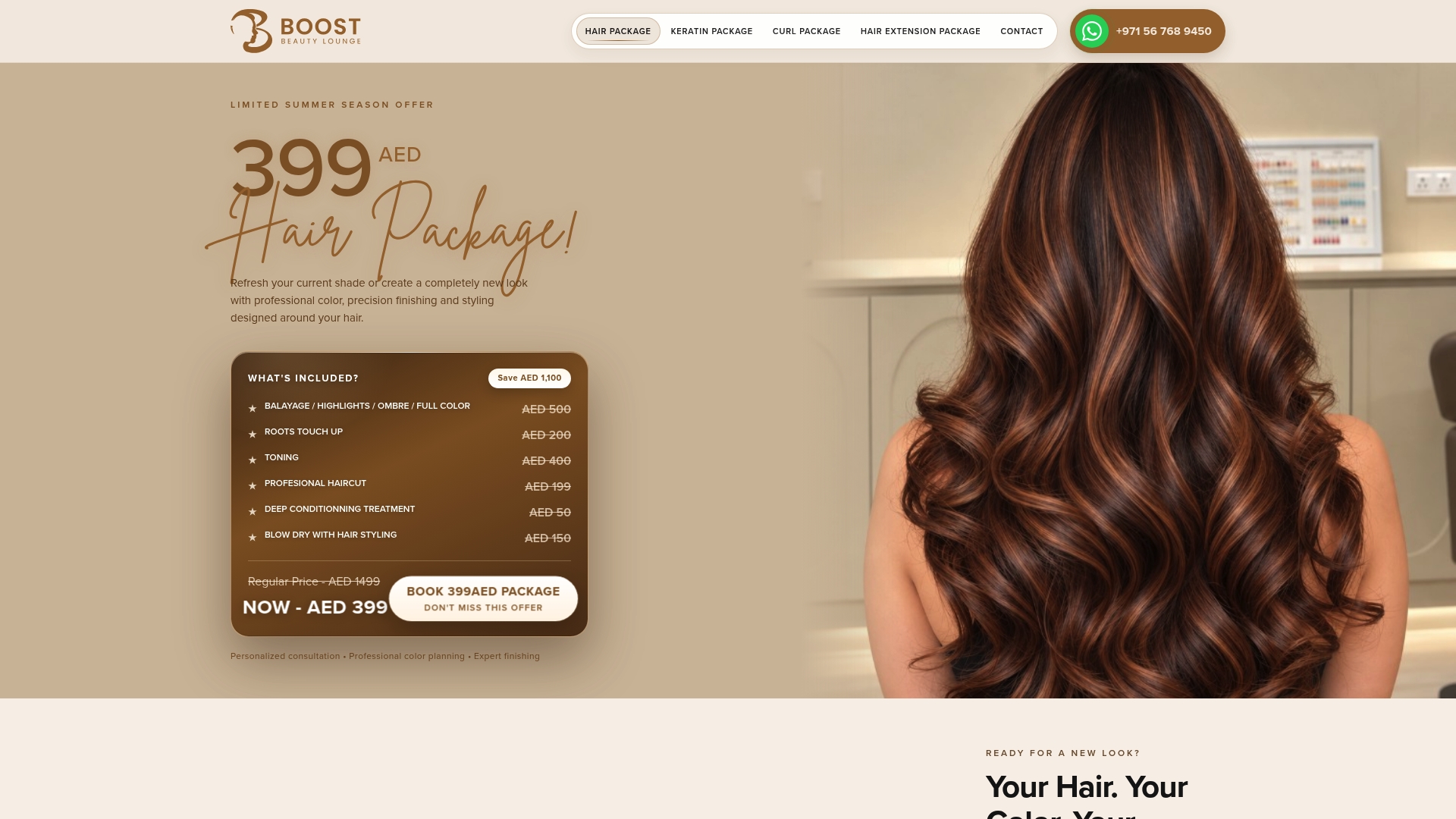
If you also want a new colour on your own hair, our Hair Package covers balayage, highlights, ombre or full colour, with roots touch-up, toning, haircut, conditioning, blow-dry and styling. It is listed at AED 1,499 one-off. We are in Deira, one minute from Salah Al Din Metro Exit 1. You can book through WhatsApp or by phone, and our Deira salon page has directions.
Our view
We plan extension colour the same way every time: shade first, then your own hair.
The most common problem is a mismatch at the ends. It happens when extensions are chosen to the root, in warm light, with no plan for what your own colour will become. We start with a consultation so the target is clear before anything is bought or applied.
We prefer to keep chemical work on your natural hair and choose extensions that are already close to the shade. Our extension package includes colour matching and blending for this reason. One plan covers both.
A fixed price for any hair length means the plan does not change the cost. You pay after the service. If the result is not right, the 10-day satisfaction guarantee applies.
Boost
FAQ
Can you dye hair extensions?
Yes, if they are 100% human hair. Darkening or toning is the safe direction, ideally after a strand test. Synthetic extensions should not be dyed with regular colour.
Can you tone hair extensions?
Yes. Toning deposits colour without opening the cuticle, so it is the gentlest colour process for extensions. It suits human hair that has turned too warm or brassy. Test a strand first.
Can you colour your own hair if you have extensions?
Yes. The usual advice is to colour your natural hair before the extensions are fitted. If you already wear them, colour is applied away from bonds, tapes, clips and seams. A stylist who plans both together gives the most even result.
How do I know what colour extensions to get?
Match to your mid-lengths and ends in daylight, using a colour ring or sample. If you are between two shades, go half a shade lighter. If your hair has dimension, blend two or three close shades. If you plan to change your colour, match to the new shade.
Sources
- SISHAIR: What hair extensions can you dye
- Can you colour your hair extensions: what to know
- Dyeing do’s and don’ts for extensions
- Can you dye hair extensions: what is safe
- Can you dye hair extensions: complete guide
- Colouring hair extensions: professional guide
- Can hair extensions be coloured
- Can I dye my hair extensions
- Colouring hair extensions tutorial
- Can you dye clip-in hair extensions
- How to dye hair extensions safely
- Hair extension colour chart decoded
- How to colour match effectively
- How to colour match hair extensions: a stylist’s guide
- Installation day no-nos
- Weft hair extension care guide
Recommended
Ready to book this look?
See this package