Deep conditioning benefits: match ingredients to your hair goals

Deep conditioning restores moisture, tames frizz, eases detangling and improves shine, with the biggest gains showing up in colour-treated, heat-styled or textured hair. The effect is cosmetic rather than curative: it smooths what is already there instead of rebuilding damaged fibre, so it works alongside trims and gentler styling habits, not as a replacement for either.
TL;DR:
- Deep conditioning is most beneficial for colour-treated, heat-styled, or textured hair that has lost moisture or lipids, requiring weekly treatment for optimal results.
- It deposits surface materials like polymers and emollients that improve softness, shine, and manageability but cannot repair internal fibre damage or stimulate growth.
- Longer-chain cationic surfactants and silicones enhance smoothing and detangling, with silicone buildup being a risk over multiple uses.
- Application should start with clean, damp hair, with treatment time varying from 5 to 30 minutes, and needs adjustment based on hair porosity and response.
- In salon, deep conditioning is integrated into tailored treatment packages with professional timing and product matching, especially for severely damaged or chemically treated hair.
Table of Contents
- Key benefits of deep conditioning
- The science behind deep conditioning: what actually changes on the hair shaft
- Who benefits and how often to deep condition
- How to choose a deep conditioner: key ingredients mapped to goals
- How to apply a deep conditioning treatment at home or in salon
- Authoritative note from Boost: salon practice and what we recommend
- Deep conditioning versus hair masks and hot oil treatments
- Editorial perspective: realistic benefits and when a salon treatment makes sense
- Booking prompt: Boost Beauty Lounge packages
- FAQ
- Sources
Key benefits of deep conditioning
A deep conditioning treatment leaves hair feeling and behaving differently almost immediately, and the reasons are specific enough to plan around.
- Moisture and frizz: humectants pull in water and emollients seal it against the cuticle, calming flyaways on humid days.
- Fewer tangles and less breakage: conditioning agents lower friction between strands, so hair glides rather than snags when you comb.
- Temporary elasticity gains: proteins fill gaps along damaged fibre and make hair feel springier until the next wash.
- Shine: smoother, flatter cuticles reflect light more evenly, which is why conditioned hair looks glossier under normal light.
- Support after colour or bleaching: treatments relubricate hair that has lost part of its natural lipid layer, improving softness without reversing the chemical change itself.
What deep conditioning cannot do matters just as much. It will not permanently repair split ends, rebuild internal fibre structure, or stimulate growth at the follicle: those outcomes depend on trimming damaged lengths and treating the scalp directly, not on surface conditioning.
The science behind deep conditioning: what actually changes on the hair shaft
Deep conditioning works by depositing material on the hair’s surface rather than altering what is underneath. Polymers, surfactants and emollients settle onto the cuticle, filling rough patches and reducing the friction that causes snagging, according to a review of conditioning physicochemistry. That deposit is also what makes hair easier to comb straight after a treatment.
Bleaching strips away part of the hair’s protective lipid layer, and suitable conditioning emulsions were able to partially or fully restore that hydrophobic surface, improving tactile feel and sliding behaviour, according to lab testing on bleached hair. That is a meaningful finding for anyone colouring or lightening hair regularly: conditioning will not undo the chemical change, but it does make the hair behave and feel closer to how it did before.
Ingredient chemistry drives how well that deposit forms. Cationic surfactants with longer carbon chains attach more effectively to the hair surface and cut wet combing force more than shorter-chain versions, based on electrokinetic analysis of conditioner behaviour. Silicones achieve a similar smoothing effect through film formation, though they carry a higher risk of buildup over repeated use; silicone-free emulsions formulated with the right surfactant chemistry can perform comparably.

Who benefits and how often to deep condition
Not every head of hair needs the same schedule, but a few patterns hold up consistently.
- Bleached or colour-treated hair benefits most, since the lipid layer lost during processing needs regular relubrication.
- Heat-styled hair gains from the added slip and surface smoothing that reduces friction damage during blow-drying or straightening.
- Curly or coily hair tends to run drier by nature and often needs conditioning more frequently to stay manageable.
- Hair extensions benefit from treatments focused on the mid-lengths and ends, where the extension bonds sit.
A weekly deep conditioning session is a reasonable starting point, adjusted by how your hair responds, according to Healthline’s practical guidance. Fine or oily hair usually needs lighter formulas and shorter contact time to avoid limpness, while low-porosity hair often responds better with added steam. Avoid daily use, and stop if you notice scalp irritation.
How to choose a deep conditioner: key ingredients mapped to goals
Reading an ingredient list with a specific goal in mind beats picking a product by marketing claims alone.
- Humectants (glycerin, panthenol) draw in moisture, useful for dry or dehydrated hair.
- Emollients and oils (shea butter, fatty alcohols) add softness and slip without necessarily adding protein.
- Cationic surfactants improve adhesion and detangling, with longer-chain versions depositing more effectively on the fibre.
- Proteins offer temporary reinforcement for damaged strands, but overuse can leave hair stiff or brittle, a pattern often called protein overload.
- Silicones deliver quick shine and smoothness through film formation, though they can build up with repeated use; some water-dispersible or silicone-free emulsions now match that performance without the same residue risk.
Pro Tip: Match the ingredient class to the symptom: reach for humectants when hair feels dry, proteins when it feels weak and limp, and emollients when it simply needs softness.
Scan for your hair’s porosity and styling routine before buying: low-porosity hair tends to do better with lighter, humectant-led formulas, while high-porosity or chemically treated hair usually needs more protein and lipid support.
How to apply a deep conditioning treatment at home or in salon
Getting consistent results comes down to preparation, timing and technique rather than the product alone.
- Cleanse or clarify first if there is product buildup, so the conditioner can actually reach the hair surface.
- Work with damp, towel-dried hair, applying the treatment from mid-lengths to ends while avoiding heavy product on the scalp unless the formula is designed for it.
- Leave it on for 5 to 30 minutes, using gentle heat or a steam cap to help low-porosity hair absorb the treatment more fully.
- Rinse thoroughly, then style as usual and note how hair feels over the following days to judge whether frequency needs adjusting.
Persistent scalp flaking, redness or itching is not something a deep conditioner addresses. That calls for a dermatologist rather than another treatment, since deep conditioners act on the hair shaft and are not designed for scalp disease, as clinical-style guidance on conditioning points out.
Authoritative note from Boost: salon practice and what we recommend
At Boost Beauty Lounge, deep conditioning is built into the Hair Package and into keratin and curl treatments, chosen through a consultation rather than a one-size-fits-all step. In salon, that means timed contact, controlled heat and a product matched to your hair’s condition rather than guesswork. Every package includes home-care instructions so the result holds up between visits, backed by a 10-day satisfaction guarantee and simple booking by WhatsApp or phone.

Deep conditioning versus hair masks and hot oil treatments
The three treatments overlap in purpose but differ in formulation and intent. A standard deep conditioner is typically a rinse-out formula focused on surfactants and emollients designed for regular, frequent use. A hair mask usually carries a heavier concentration of proteins, oils or butters, intended for less frequent, more intensive sessions, though the line between “deep conditioner” and “mask” is often more about marketing than mechanism.
Hot oil treatments work differently again. Rather than relying on surfactant deposition, they coat the hair in oil, often warmed to help it spread, which lubricates the surface and reduces friction in a similar way to emollient-rich conditioners but without the polymer or protein content that drives longer-lasting manageability gains. Hot oil tends to suit very dry or coarse hair well, while fine hair can end up weighed down.
None of the three permanently repairs fibre damage. The sensory improvement from any of them, smoother feel, easier combing, comes mainly from reduced surface friction rather than from nourishment reaching the follicle, a distinction worth keeping in mind when comparing products by how “intensive” they claim to be. Choosing between them is less about which is strongest and more about matching formulation weight to your hair’s density and how often you are willing to do the treatment.
Editorial perspective: realistic benefits and when a salon treatment makes sense
Weekly at-home conditioning handles most routine dryness and frizz well. Where it falls short is complex colour work, severe heat damage or extensions, situations where product choice and timing matter more than a standard box treatment allows. That is when a professional session, like those built into Boost’s packages, earns its place, and booking is straightforward through WhatsApp or phone, backed by a 10-day guarantee.
— Boost
Booking prompt: Boost Beauty Lounge packages
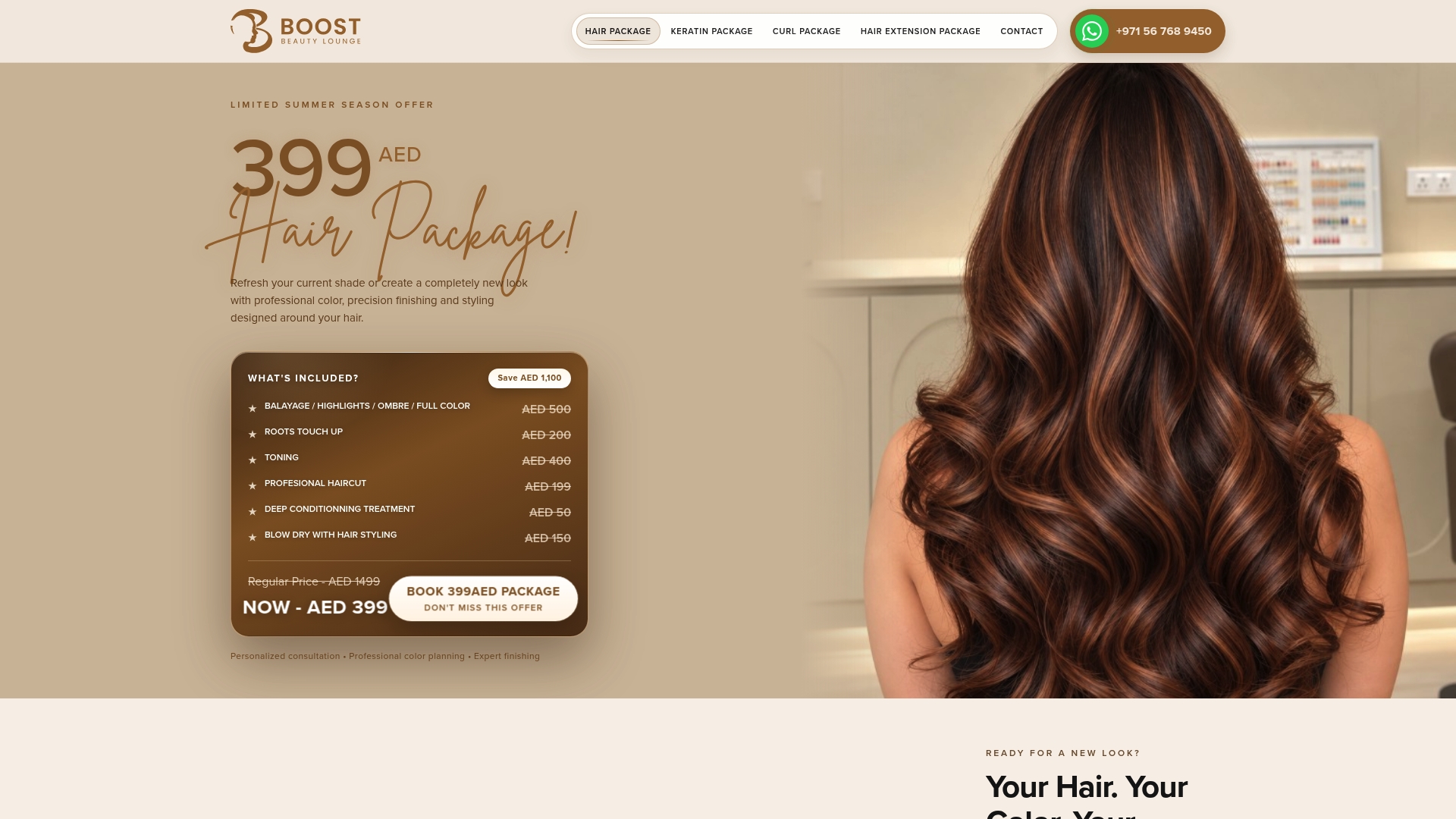
Deep conditioning works best paired with the right colour or treatment plan, which is often the focus of professional hair treatment packages. Pricing is normally fixed in advance to avoid surprises once the service is completed.
| Package | What it includes | Price |
|---|---|---|
| Hair Package | Consultation, colour, deep conditioning, blow-dry and styling | 1,499 AED |
| Keratin/Protein/Botox Package | Smoothing treatment with conditioning steps | 1,299 AED |
| Curl Package | Curl definition with supporting conditioning | 999 AED |
| Hair Extension Package | Extensions with colour matching and blending | 1,499 AED |
Booking is commonly done through website, WhatsApp, or phone, with payment typically taken after the service is completed.
FAQ
Is it good to do a deep conditioning treatment?
Yes, for most hair types, especially colour-treated, heat-styled or textured hair that needs extra moisture and slip. It will not reverse chemical or heat damage, but it reliably improves softness, shine and manageability between treatments.
How long does a deep conditioning treatment last?
The smoothing and moisture effect typically fades over several washes as the conditioning deposit gradually rinses away. Most people notice they need to repeat the treatment within a week or so to maintain the same feel, which is why weekly application is a common starting point.
Is it okay to deep condition my hair every day?
Daily use is generally not necessary and can leave fine or low-porosity hair feeling heavy or greasy from product buildup. A weekly routine, adjusted based on how your hair responds, works better for most people.
Can deep conditioning make hair grow?
No, deep conditioning works on the hair shaft’s surface and does not affect the follicle, so it does not stimulate growth. It can reduce breakage along the length of the hair, which helps existing length hold up better over time.
Sources
- Effects of Cosmetic Emulsions on the Surface Properties of Mongolian Hair | ACS Omega
- Physicochemical aspects of the performance of hair-conditioning formulations (Cosmetics review)
- Electrokinetic analysis reveals common conditioner behaviours (International Journal of Cosmetic Science)
- How to deep condition hair (Healthline)
Recommended
Ready to book this look?
See this package