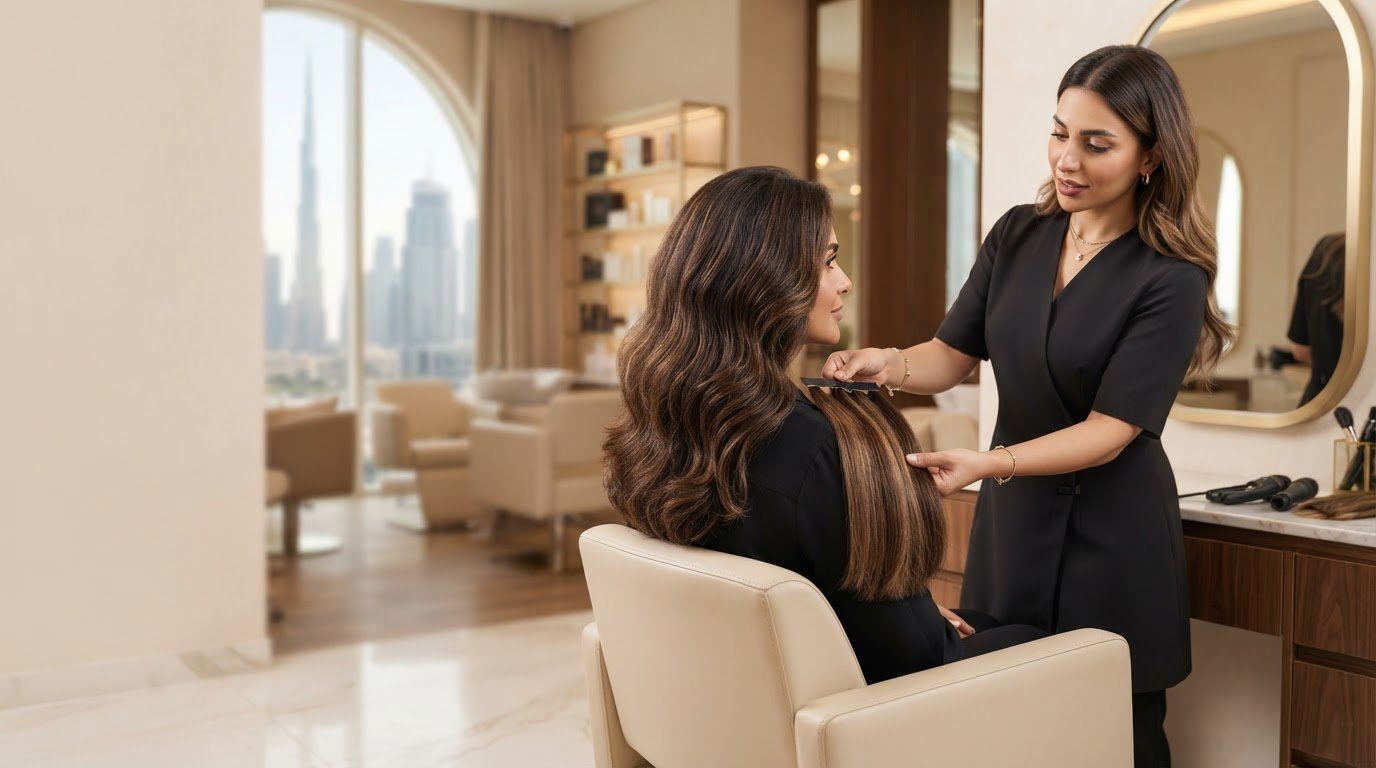
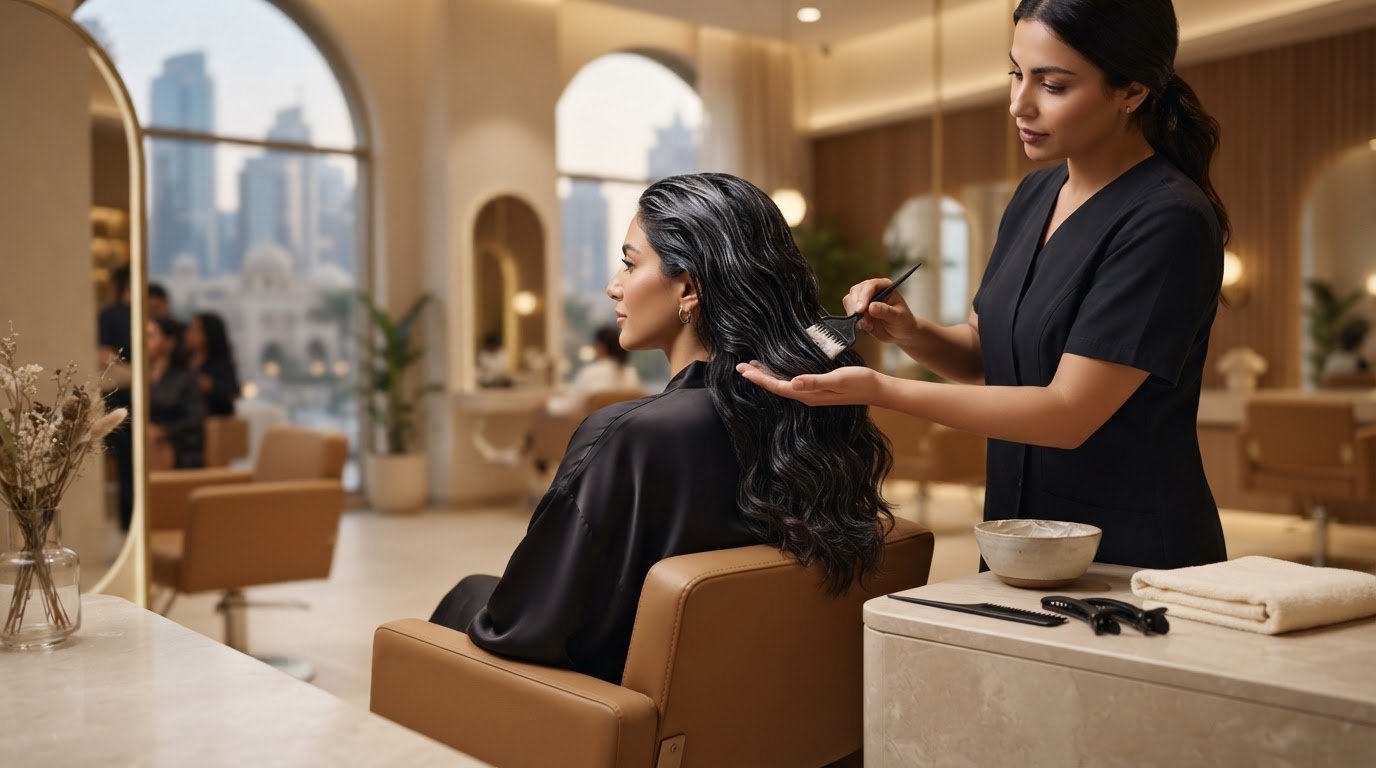
Avoid Returns: Color Match Extensions in Dubai With 3 Lights & Sample

The fastest way to get extensions that disappear into your hair is to check your colour in natural daylight, match to your mid-lengths rather than your roots, and confirm the shade with a physical sample or a professional consult. Photos and colour charts get you close, but a swatch held against your hair in daylight is the only test that removes guesswork. Skipping that step is the single biggest reason online extension orders end up returned.
TL;DR:
- Matching extensions to your mid-lengths and ends in natural daylight prevents darker roots from causing mismatches and ensures a more seamless blend.
- Using a physical swatch held against your hair in genuine daylight provides the most accurate shade confirmation before purchasing.
- Photographing your hair under three lighting conditions—indoor, natural window, and outdoor sunlight—helps accurately identify your undertone and improve color matching.
- Ordering a small physical sample is the most reliable way to verify the match, especially for multi-tonal, textured, or blond hair, reducing costly returns.
- Professional salon consultations are recommended for complex hair colors, balayage, or heavily layered textures to achieve a precise, personalized extension match.
Table of Contents
- Step-by-step method to match extensions at home
- How to order and use sample swatches or colour-match kits
- What to expect from photo-based and live video color-match services
- How to match balayage, highlights and multi-tonal hair
- Matching extensions for curly, coily and textured hair
- Frequent matching mistakes and quick fixes
- When a salon consult is the better route: Boost Beauty Lounge’s offering
- A first-person note from Boost on avoiding mismatches
- Booking and what to expect at Boost
- Authoritative resources and sample suppliers
- Sources
- FAQ
Step-by-step method to match extensions at home
Getting this right at home comes down to controlling light and choosing the right reference point on your head. Most mismatches happen because people photograph their roots under a warm bulb and then compare that image to a swatch photographed in daylight. The fix is a simple, repeatable process.
- Photograph your hair in three lighting conditions: natural window daylight, indoor overhead light, and direct outdoor sunlight. Take root-to-tip shots plus a back-of-head shot and a side profile in each setting, with your hair down and unfiltered.
- Identify your undertone before you pick a shade. Hold gold and silver jewellery against your skin, or check the colour of your wrist veins: warm undertones usually suit richer golden or copper-toned extensions, cool undertones suit ash or neutral shades, and if neither test is conclusive you probably have a neutral undertone.
- Match to your mid-lengths and ends, not your roots. Roots are often a shade or two darker due to regrowth or natural shading close to the scalp, and extensions clip in or attach below that zone, so the mid-shaft and ends are the honest reference point.
- Compare your photos against a chart or swatch in the same three lighting conditions. Label each photo by light source so you are never comparing a daylight swatch to an indoor photo.
- When your hair sits between two shades, the safer choice is usually to go slightly lighter, since darker extensions are harder to blend and more noticeable at the join. Some people instead order two adjacent shades and mix a few wefts of each.
Professional cosmetology training backs the undertone step specifically. Guidance on choosing the right extensions for your client stresses that background pigment and undertone matter as much as the surface shade, and that many mismatches trace back to skipping this check rather than picking the wrong level of lightness.
Following a structured three-light photo method before ordering is also the basis of most professional colour-match services. One international guide to colour matching remy hair extensions recommends photographing hair in window light, indoor overhead light and direct sunlight specifically because it gives sellers or stylists the clearest possible basis for a match, rather than relying on a single photo taken in whatever light happens to be available.
Pro Tip: Keep last season’s roots-touch-up photo on your phone as a backup reference. If your hair has faded or lightened since your last colour appointment, comparing against an old photo will send you shopping for the wrong shade.
Once you have your three-light photo set and an undertone read, you are ready to either place an order with confidence or move to the sample-testing stage covered next.
How to order and use sample swatches or colour-match kits
A sample swatch is a small physical strand, usually a few centimetres wide, cut or wefted from the same batch as the full extensions you would buy. It is the single most reliable check available before committing to a full set, because it removes screen colour variation, camera white balance and lighting guesswork from the equation entirely.
Using a sample correctly matters as much as ordering one. A rushed comparison under the wrong light defeats the purpose.
- Wash and dry your hair as you normally would, since product buildup or oil can shift how light reflects off it.
- Check the swatch against your hair in natural daylight, ideally near a window in the late morning or early afternoon.
- Hold the swatch at the mid-length of your hair, where the extensions will actually sit, not against your roots.
- View the comparison at arm’s length first, then step back a metre or two, since colour differences that vanish up close sometimes reappear from a normal conversation distance.
Sample kits are generally inexpensive and quick to arrange. Following a three-light photo method before ordering, sellers following this approach report that most customers get a correct match on their first physical sample, according to one guide to colour matching remy hair extensions, and international sample shipping fees are typically low. Many salons also keep their own physical swatch rings in-house, which is worth asking about if you would rather test in person than wait for delivery.
If none of the swatches you try are a clean match, you have three practical options: mix wefts from two adjacent shades to average out the difference, ask a stylist to tone the extensions slightly warmer or cooler, or have the extensions custom dyed to match your exact colour. Custom dyeing works best on human hair extensions and should be done by someone experienced with the material, since over-processing weakens the hair and can shorten its lifespan.
What to expect from photo-based and live video color-match services
Online colour-match services generally fall into three types: an instant quiz that guesses a shade from a few multiple-choice questions, a photo-upload service where you send images and an expert replies with a recommendation, and a live WhatsApp or video consult where a stylist looks at your hair in real time. Quizzes are fast but the least accurate, since they rely on you describing your own colour rather than someone assessing it directly.
Photo-upload services tend to be the most common and, done properly, reasonably reliable. Many extension sellers offering free photo-based colour matching typically ask for two to four clear photos and return a recommendation within 24 to 48 hours, according to Cliphair’s colour-matching service page. To get a useful answer, take your photos against a neutral background with no filters, hair worn down and unstyled, and include a root-to-tip shot alongside a back-of-head and profile view, camera held at arm’s length rather than close up.
When you get a response, ask specific questions rather than accepting a single shade number:
- Is there a single best-match shade, or would mixing two shades give a closer result?
- What is my undertone, and does the recommended shade account for it?
- Would a rooted or balayage option blend better than a solid single tone?
- Does my natural hair need salon tinting first for the extensions to sit correctly?
Pro Tip: Save the consultant’s written recommendation, including any shade codes mentioned, so you can compare it against a physical sample if the first order does not look quite right.
Treat online advice as a strong starting point rather than a final answer. It works well for most single-tone hair colours, but if your hair is multi-tonal, very light blonde, or has visible regrowth, order a physical sample before committing to a full set.
How to match balayage, highlights and multi-tonal hair
Multi-tonal hair gives you two legitimate matching strategies, and which one suits you depends on how much dimension you want the extensions to carry themselves.
- Match the base colour only, then let your natural highlights frame the extensions from the top layers, which works well if your highlights are concentrated near the crown and face-framing pieces.
- Choose rooted or balayage extensions that already carry a gradient similar to your own, which suits hair with dimension running through the mid-lengths and ends rather than just at the top.
Retailers commonly stock rooted, balayage or multi-tonal extension wefts for exactly this reason, and several recommend mixing two adjacent shades when a single option is not available, according to Bombay Hair’s colour-match guidance. When mixing, the usual approach is to place the lighter weft pieces where your natural highlights are strongest, typically face-framing sections and the crown, and the deeper shade underneath and at the nape.
Custom dyeing or salon blending becomes the better choice when your colour has more than two distinct tones, when your highlights are heavily balayage rather than foiled, or when a mail-order sample simply will not stretch to match a complex pattern. For dimensional work like this, a salon-based test section followed by tonal toning is often quicker and cleaner than working through several rounds of mail-order exchanges.
Matching extensions for curly, coily and textured hair
Curl pattern changes how colour reads to the eye, which catches a lot of people out. Curly and coily hair often looks a shade or two darker than it actually is, because tighter curls create more shadow and less flat surface to reflect light back at you.
The fix is to match while your hair is in its natural, styled state rather than stretched straight. A colour that looks correct on blow-dried, straightened hair can look noticeably darker once your curls spring back into their usual pattern.
- Test swatches or photos against your hair after it has dried into its normal curl pattern, not straightened or stretched.
- Choose extensions in a slightly lighter shade than you might otherwise pick, since the curl’s natural shadowing will read the colour a touch darker once installed.
- Match texture as well as colour: a straight-textured weft blended into tightly coiled hair will stand out regardless of how close the colour is.
- For complex textured blends, particularly transitioning or heavily layered natural hair, book a specialist consult rather than guessing from photos alone.
Specialist guides on matching for textured hair make the same point: matching should happen with hair in its natural curl state, and shade selection should be adjusted to account for that shadowing rather than matching against straightened hair, according to one international colour-match guide.
Pro Tip: If you regularly switch between straightened and natural curl styles, choose your extension shade based on whichever state you wear your hair in most often, since that is the look you need it to blend into day to day.

Frequent matching mistakes and quick fixes
Most extension returns trace back to a small handful of avoidable errors. Catching these before you order saves both money and a second wait for shipping.
| Common mistake | Why it causes a mismatch | Quick fix |
|---|---|---|
| Matching to roots instead of mid-lengths | Roots are often darker due to regrowth or scalp shading | Match against mid-shaft and ends, where extensions actually sit |
| Comparing photos taken in different light | Warm indoor bulbs shift colour warmer than daylight | Photograph and compare in the same light, ideally daylight |
| Ignoring undertone | Two shades can look similar in tone but clash in warmth | Do a quick jewellery or wrist-vein check before ordering |
| Ordering a full set without a sample | Screen colours and lighting vary between devices | Order a small physical swatch first, or book a consult |
| Not checking the return policy | Full sets can be costly to exchange if the match is wrong | Confirm exchange terms before you buy |
When a salon consult is the better route: Boost Beauty Lounge’s offering
Some colour situations are genuinely hard to solve from a photo alone: heavy balayage, multiple tones through the mid-lengths, or hair that has been through several rounds of colour and needs professional toning before extensions will sit correctly. That is where an in-salon consult earns its place over a mail-order sample.
At Boost Beauty Lounge, the process starts with an in-person consultation before anything is cut, dyed or fitted. A stylist assesses your natural colour and undertone directly, tests a section against sample wefts, and only then recommends toning, custom dyeing or a specific extension shade.
- The AED 399 hair colour transformation package covers balayage, highlights, ombre or full colour, alongside roots touch-up, toning, haircut, conditioning, blow-dry and styling.
- The salon is based in Deira and offers consultation-based colour planning rather than a fixed menu.
- Payment is taken after the service is completed, and every colour treatment comes with home-care guidance and a satisfaction guarantee.
- Stylist profiles and before-and-after galleries are available on the site for anyone who wants to see previous colour work.
Book a salon consult specifically when your hair has multiple tones, a textured or curly blend, or needs professional dyeing to match extensions cleanly. A quick photo consult or a mail-order sample is usually enough for a single, even natural shade.
A first-person note from Boost on avoiding mismatches
The mismatches we see most often at the salon come from clients matching to a photo taken under the wrong light, or matching to their roots rather than where the extensions will actually sit. Both are easy mistakes and both are avoidable with a five-minute daylight check before anything gets ordered.
That is why we start every extension consultation by testing a sample section against a client’s real hair, in the salon, before recommending a shade or a toning plan. Our stylist profiles and before-and-after galleries show the range of matches we have handled, and every colour service carries a 10-day satisfaction guarantee, so a client is never stuck with a result that does not sit right.
— Boost
Booking and what to expect at Boost
If your hair is a single, fairly even shade, a daylight photo check and a mail-order sample will usually get you a clean match without needing a salon visit at all. Where a professional consult earns its cost is when your colour has depth, multiple tones, or needs toning before extensions will blend properly, and that is exactly the gap Boost Beauty Lounge fills.
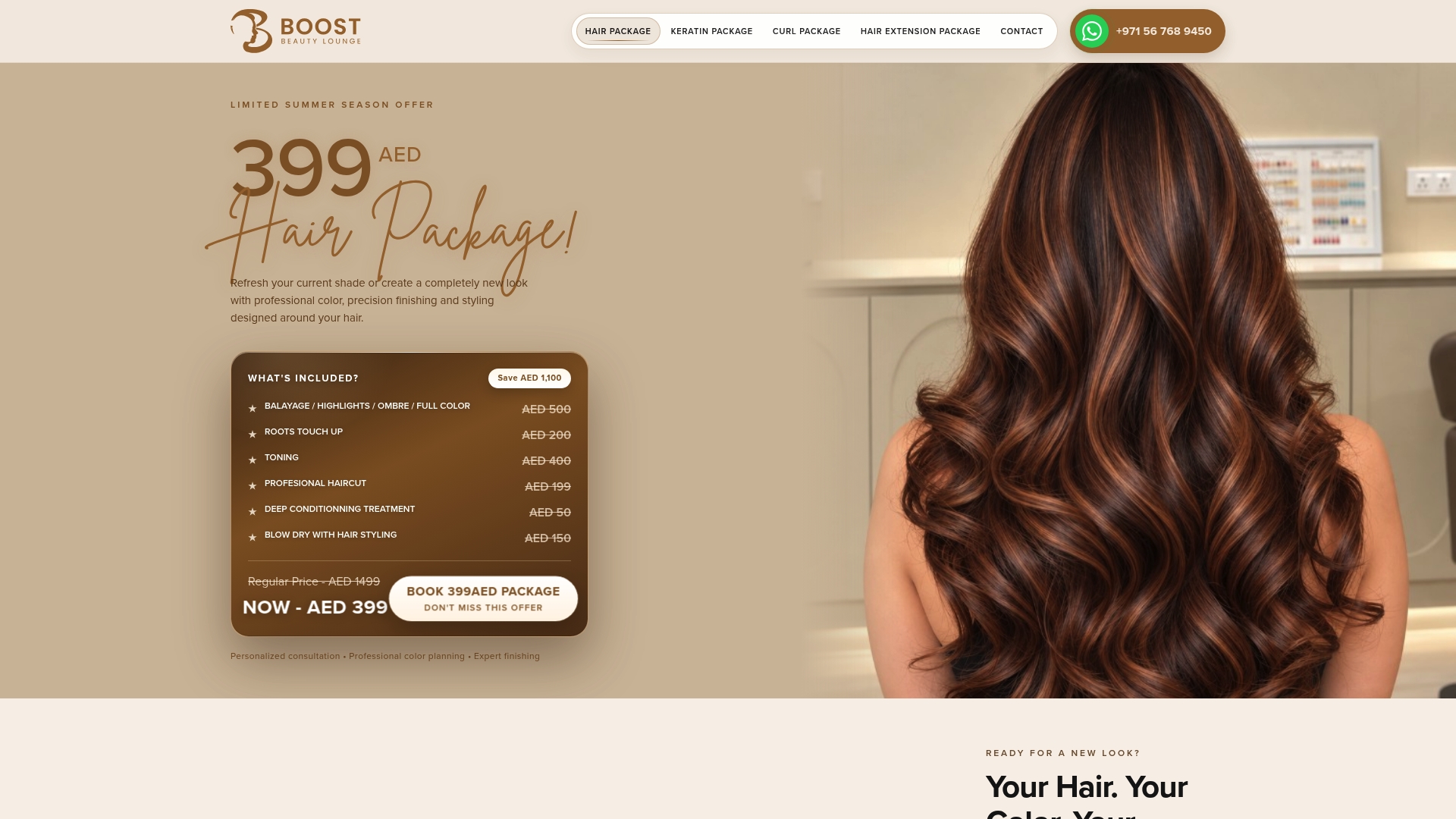
The Hair Package runs at AED 399 for a full colour transformation, balayage, highlights or ombre, plus roots touch-up, toning, haircut, conditioning, blow-dry and styling, with the shade plan built around your consultation rather than a fixed chart. For extensions specifically, the Hair Extension Package covers fitting and colour matching in the same consultation-first way.
- Book through the landing page, WhatsApp or by phone.
- Payment is taken after the service.
- Every colour service includes a satisfaction guarantee and home-care guidance.
| What you get | Detail |
|---|---|
| Package | Hair Package, AED 399 one-off |
| Location | Deira, one minute from Salah Al Din Metro Exit 1 |
| Payment timing | After service completion |
| Guarantee | 10-day satisfaction guarantee |
Authoritative resources and sample suppliers
A handful of outside resources are worth bookmarking alongside your salon consult, particularly if you want to try a DIY sample first.
- Cliphair’s colour-matching service offers a free photo-based match with a 24 to 48 hour turnaround, useful for a quick second opinion.
- GOO GOO Hair’s expert colour matching sets out clear photo do’s and don’ts, helpful if you are unsure how to frame your shots.
- Bombay Hair’s colour-match page explains mixing shades and rooted or balayage options for dimensional hair.
- Brillare Beauty Institute’s guide to extensions covers the professional reasoning behind undertone checks, useful background if you want to understand why the jewellery test works.
- The international colour-match guide from Hair Extensions Luxe sets out the three-light photo method in full detail.
Sources
- Color Match Remy Extensions Online 2026 — International Guide | Hair Extensions Luxe
- Choosing the right extensions for your client | Brillare Beauty Institute
- Color Match Hair Extensions - Cliphair US
FAQ
How can I match my hair colour to extensions?
Photograph your hair in natural daylight, indoor light and direct sunlight, then compare against a swatch or chart at your mid-lengths rather than your roots. Confirming with a physical sample or a professional consult gives the most reliable result before you commit to a full order.
How do I figure out what colour extensions to get?
Start with an undertone check using gold or silver jewellery or your wrist veins, then match the shade to your mid-shaft and ends in natural light. If your hair sits between two shades, choosing slightly lighter or mixing two adjacent shades usually blends better than going darker.
How do I colour match hair extensions online?
Most sellers offer a free photo-based service where you upload two to four clear photos, including root-to-tip, back and profile shots, and receive a recommendation within 24 to 48 hours according to Cliphair. Ask whether a rooted option or shade mixing suits your hair better, and order a physical sample if your colour is multi-tonal or very light.
How do I get extensions that match my natural hair colour?
Match to your mid-lengths and ends, check your undertone, and confirm with a physical swatch held against your hair in daylight before ordering a full set. For textured or curly hair, test in your natural curl state, and for complex multi-tonal colour, a salon consult such as the one offered at Boost Beauty Lounge can test a sample section against your hair directly.
Recommended
Ready to book this look?
See this package