Colour Banding Fix: Hair Stripes and Screen Gradients

Colour banding means visible stripes or steps where colour should change smoothly. In hair, it shows as lines of different tone after highlights, balayage, ombre or a root touch-up. On a screen or in a photo, it shows as steps in a sky or gradient. The hair fix is a staged correction by a stylist. The screen fix is a higher bit depth, less compression or a display setting. This guide covers both, starting with hair.
TL;DR
- Hair banding is uneven colour in bands, usually caused by overlapping lightener, old colour on the lengths or a missed section.
- The safest fix is a consultation, a strand test and a staged plan, not a stronger product at home.
- Toner can even out tone, but it cannot remove a band that comes from uneven lift.
- For photos and screens, use higher bit depth, add a little noise and check the display colour range.
- Boost Beauty Lounge in Deira, Dubai, plans colour after a consultation and offers a 10-day satisfaction guarantee.
Table of Contents
- What colour banding looks like in hair
- Why bands appear after colouring
- How a salon fixes colour banding
- What to avoid at home
- How to avoid banding with balayage, highlights and ombre
- Our perspective
- Book your colour in Deira
- If you meant banding on a screen or in a photo
- FAQ
- Sources
What colour banding looks like in hair
Banding in hair is a horizontal line or stripe. One section looks lighter, darker, warmer or cooler than the section next to it. You may see it in these places:
- A clear line where new colour stops and old colour starts.
- Stripes of yellow, orange or red in a lightened section.
- A darker band at the roots and a lighter band mid-length.
- A stripe where one foil or one brush stroke overlapped another.
- Hard edges in an ombre that was meant to fade softly.
Check your hair near a window in daylight. Salon and home lighting is often warm and hides the difference. Look at the roots, the mid-lengths and the ends separately and note where the tone changes.
Why bands appear after colouring
Most bands come from a small number of causes. Knowing which one applies to you decides the fix.
Overlapping lightener
When lightener is brushed over hair that was already lightened, that section lifts further than the rest. The result is a lighter stripe. This is common when roots are touched up and the product drags into the lengths.

Old colour on the lengths
Dye does not lift like natural pigment. Box colour, henna or earlier salon colour can sit in the lengths and ends. New lightener then lifts them differently from the regrowth. The two areas end up as different tones.
Uneven hair condition
Hair is not the same from root to tip. Ends are usually more porous than roots. Porous hair takes colour and loses it faster, so tones can differ along the length even when the same formula was used.
Uneven application
Sections that are too thick, a missed area or colour left on for different times can all leave a band. Thick, dark hair also shows underlying warmth quickly once it is lifted.
Toner that has faded
A fresh toner can hide differences. As it fades, the underlying warm tone comes back in some sections before others. Bands that were not visible on the day appear a few weeks later. Our guide on when to tone hair after highlights and balayage explains the timing.
How a salon fixes colour banding
A correction works best as a plan. These are the steps we follow in a consultation-based approach.
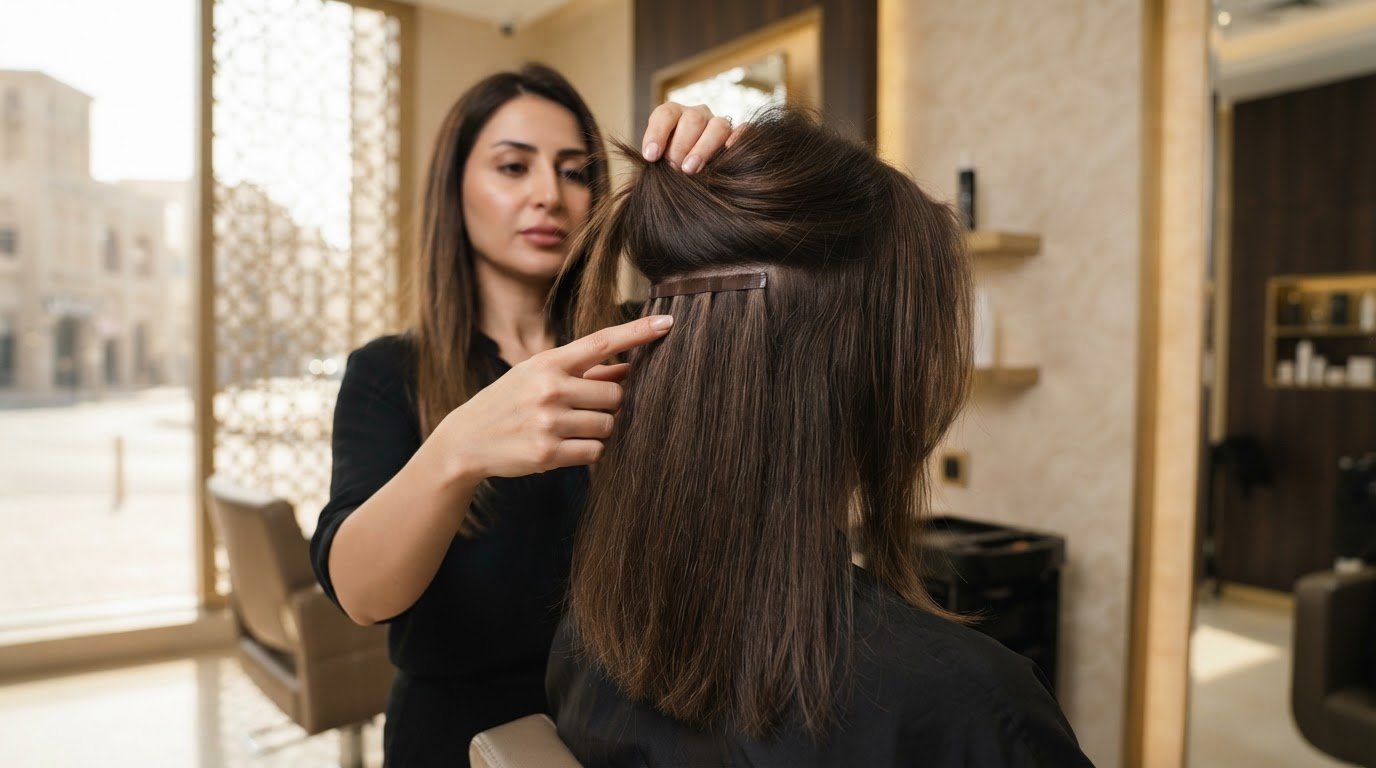
- Consultation. The stylist asks about your hair history: box dye, henna, past salon colour, heat styling and treatments. Photos of your previous colour help.
- Daylight check. The stylist looks at the bands in natural light and decides which tone is the problem: yellow, orange, red or a dark band.
- Strand test. A small section is treated first to show how your hair reacts. Our page on the hair colour strand test in 6 steps shows how this works.
- Choosing the route. If the band is a tone problem, a toner may be enough. If it is an uneven lift, the lighter or darker section needs to be matched to its neighbours.
- Evening the canvas. In some cases a colour is applied first to even out the base. Lightening then follows over a more uniform surface.
- Blending, not one hard line. Fine placement softens the edge between sections so no single line remains.
- Toning and conditioning. Toner sets the final shade. Deep conditioning helps the hair after colour work.
- Home-care guidance. The stylist explains how to wash, protect and refresh the colour to keep it even.
Some banding needs more than one session. Hair that has been lightened several times should not be pushed too far in one visit. Our article on professional versus DIY colour correction in Dubai goes through when a salon visit is the better route.
When toner is enough
Toner changes tone. It does not make hair lighter or darker in a big way. If a band looks yellow or orange against a cooler section, a matched toner can bring them closer. Choosing the formula depends on how light the hair has been lifted. Read how to match a toner formula to your lift level before you pick one. For brown hair that has turned warm, see toner for brunette hair. For a broader view of warm tones, our guide to fixing brassy hair covers products and salon options.
When the hair needs a staged plan
If a band is the result of uneven lift, toner alone will not remove it. The plan then has several stages with time between them. This protects the hair and gives a more even result. It also applies when you want a pale shade. Our guide on balayage for Asian hair and staged sessions explains why dark, strong hair is lightened over more than one visit.
What to avoid at home
Banded hair is already uneven. Home steps can make it more uneven.
- Do not apply a stronger lightener over the bands. It adds more lift to areas that already lifted, which usually increases the contrast.
- Do not use box dye over the whole head to hide a stripe. The dye sits unevenly on hair that has different porosity.
- Do not skip the strand test. A small test shows how the hair reacts before the full head is treated.
- Do not repeat colour in the same week. Give the hair time and ask a stylist about the right interval.
- Do not judge the shade under warm light only. Check it in daylight.
If you have a skin reaction history, a patch test is needed before colour. Our page on hair colour for brown skin and the 48-hour patch test covers this step.
How to avoid banding with balayage, highlights and ombre
Banding is easier to prevent than to fix. These habits help.
Plan the colour before the day
Bring photos of the shade you want and photos of your past colour. Tell the stylist about every product used in the last year. A consultation before colour is the step that prevents most stripes.
Choose a placement that grows out softly
Balayage and ombre are painted by hand, so the edge can be blended. This helps when the colour grows out. Short hair has its own rules, and balayage on short hair with a tone refresh every 8 to 12 weeks shows what upkeep looks like.
Keep tone fresh
Book a tone refresh before warmth shows. A shade that fades unevenly is the start of visible bands. Use the care instructions your stylist gives you.
Match added hair carefully
Extensions can create a banding effect when their colour does not match your own. Matching in several lights and with a sample avoids this. Our guide on colour matching hair extensions in Dubai explains the method.
Our perspective
Banding is a planning problem more than a product problem. In our experience, a stripe appears when the colour was applied without a clear picture of the hair underneath.
That is why we start with a consultation. We look at your hair history, the length you have and the shade you want. Then we agree the plan before any colour is applied.
Our hair colour packages are fixed-price, for any hair length, and you pay after the service is completed. The package covers balayage, highlights, ombre or full colour with roots touch-up, toning, haircut, conditioning, blow-dry and styling. We give home-care instructions and offer a 10-day satisfaction guarantee.
If you are unsure whether your hair needs a toner or a staged correction, tell us at the consultation. We would rather agree the right plan with you than guess.
Boost
Book your colour in Deira
Boost Beauty Lounge is in Deira, one minute from Salah Al Din Metro Exit 1. Our Hair Package is a fixed-price colour transformation for balayage, highlights, ombre or full colour, with toning, conditioning, blow-dry and styling included. Booking is through WhatsApp or by phone.
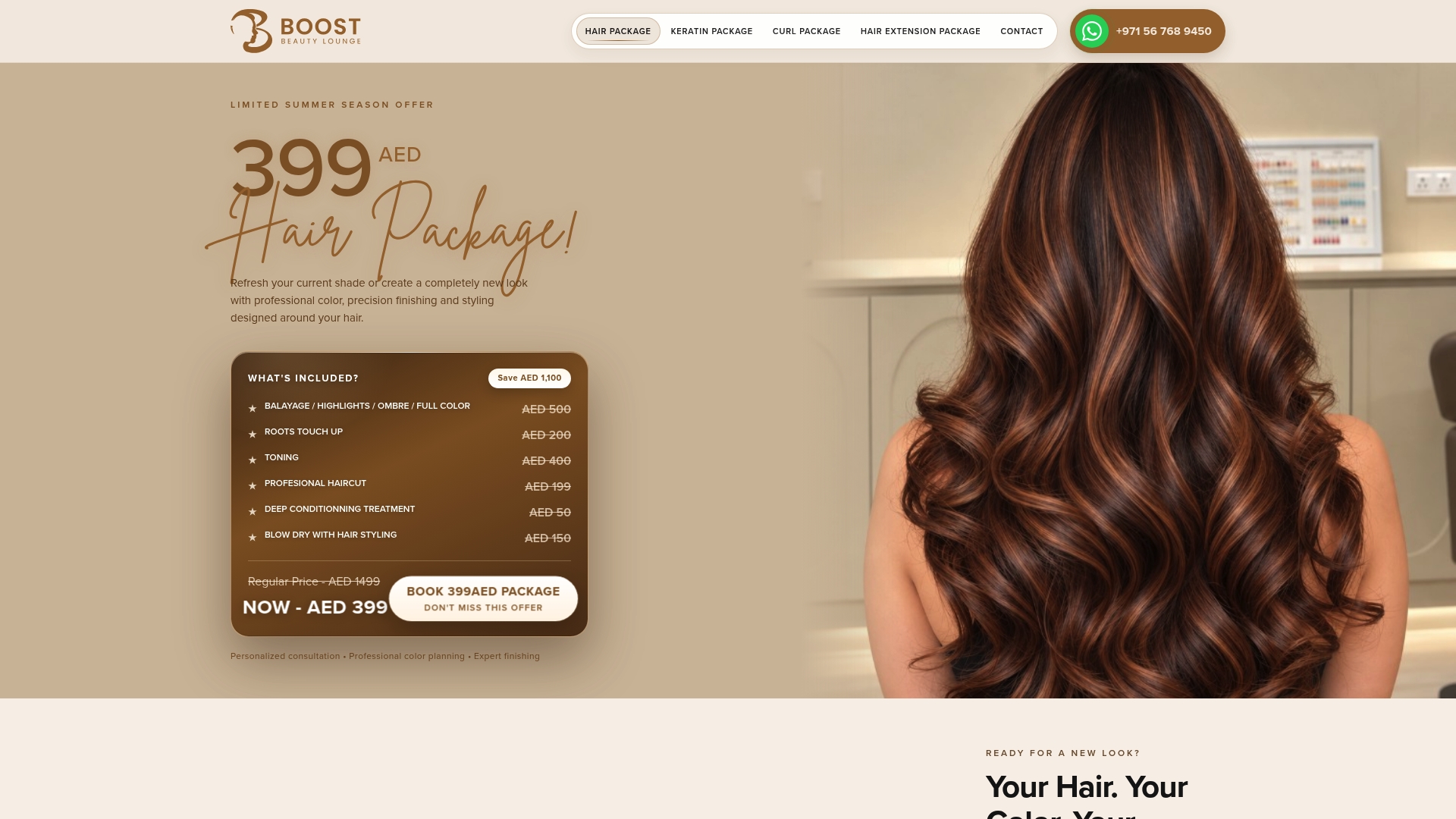
If you also want smoother or more defined hair, we have a Keratin/Protein/Botox Package at 1299 AED and a Curl Package at 999 AED. Our Hair Extension Package at 1499 AED includes colour matching and blending.
If you meant banding on a screen or in a photo
The same word is used in imaging. Here the fix is technical.
What it is and how to spot it
In images, banding is visible steps or lines between tones that should blend smoothly. Look at skies and shadows at 100% zoom. These are the areas where it shows first.
What causes it
The same source lists the usual causes: heavy tonal adjustments, limited bit depth, strong noise reduction, strong saturation changes, JPEG compression and repeated saving or exporting. Flickering LED or fluorescent light can cause straight-line banding in the capture itself, and the fix there is a different shutter speed.
Fixes for photos, gradients and video
- Edit less. Make smaller adjustments and avoid saving the same file again and again.
- Use Dither in Photoshop. The Dither setting adds a noisy blend between colours that reduces banding in gradients.
- Add a little noise. In After Effects, a small amount of noise, adjusted in steps of about 1 to 2%, can hide banding.
- Raise the bit depth. In the same tutorial, switching from 8 bits to 16 or 32 bits per channel improves banding in After Effects.
- Preview properly. You may not see banding in previews if you cannot preview in the right colour space or codec.
Fixes for a monitor or TV
A display guide on banding suggests checking that the colour range is set to Full instead of Limited if your monitor supports it, turning off night light or colour-temperature filters, and testing with smooth gradients. The range setting is found in your graphics card control panel, and a Full 0 to 255 versus Limited 16 to 235 mismatch can cause banding.

FAQ
Can toner fix colour banding in hair?
Toner can fix banding that is a tone problem, such as a yellow stripe next to a cooler section. It does not change uneven lift. A stylist can tell you which one you have after a daylight check and a strand test.
How many visits does it take to fix banded hair?
It depends on your hair history and how uneven the colour is. Simple tone differences may be corrected in one visit. More uneven hair may need a staged plan, which your stylist explains at the consultation.
Why did the bands appear weeks after my appointment?
A fresh toner can hide differences. When it fades, the warm tone underneath returns in some sections before others. A tone refresh and the home-care steps your stylist gave you help keep the colour even.
How do I fix banding in a photo or on a TV?
For photos, use a higher bit depth, make smaller edits, avoid repeated saving and add a little noise or dither. For a screen, check that the colour range is set to Full and turn off night light filters.
Sources
- What Is Banding in Photos? Causes, Detection and How to Fix It
- Fix Banding in Gradients by Turning On a Photoshop Setting
- How to Add Noise and Grain in After Effects
- Remove banding in After Effects, Premiere, and everywhere
- Color Banding on Monitors and TVs: Causes, Test and Fixes
Recommended
Ready to book this look?
See this package