Avoid the No.1 Blend Mistake: Book a Salon Fit to Match Extensions in Dubai
The simplest route to a seamless blend is choosing an attachment method that suits your hair’s density and lifestyle, matching colour to your mid-lengths and ends rather than your roots, and finishing with a professional cut. If your colour is multi-tonal or your hair is shorter than shoulder length, book a consultation before you buy anything. A skilled stylist will save you from the two mistakes that ruin a blend: the wrong method and a root-matched shade.
TL;DR:
- Matching extensions to mid-lengths and ends, not roots, is crucial for a natural blend, especially for multi-tonal hair or shorter styles.
- Techniques like tape-ins, halo, or clip-ins each suit different lifestyles and hair densities, with placement and layer staggering vital for invisibility.
- Proper colour matching involves testing in daylight against your ends, respecting texture differences, and choosing Remy human hair for consistency.
- Regular refits every six to twelve weeks and proper care during removal prevent scalp damage and maintain extension longevity.
- Booking a professional consultation ensures correct method, shade, and cut, avoiding common mistakes like matching to darker roots that ruin a seamless blend.
Table of Contents
- Which hair extension method actually blends best for you?
- How do you colour match extensions for a natural look?
- Where should tracks sit to hide the join?
- What cutting and styling techniques make extensions disappear?
- How often should you refit and care for extensions?
- What does a professional blending service actually involve?
- The one mistake that ruins most blends
- Book a blending consultation with Boost Beauty Lounge
- Sources
- FAQ
Which hair extension method actually blends best for you?
The method matters more than the brand. Fine, thinner hair generally needs something lightweight that will not tug at the root, while thicker or coarser hair can carry more weight without showing the join.
- Clip-ins and seamless clip-ins: no commitment, in and out in minutes, ideal for occasional wear or testing a length before going semi-permanent.
- Halo extensions: sit on a wire under the crown, good for volume without any bonding, though less secure during high-impact activity.
- Tape-ins: lie flat against the scalp and tend to blend most naturally for many wearers, especially if you usually wear your hair down.
- Micro-bead, nano and i-tip: fully customisable placement, but less suited to very oily scalps, since product build-up around the bond can cause slippage.
- U-tip and hot-bond: strand-by-strand, semi-permanent, good for adding density evenly through fine hair.
- Sew-in weft and hand-tied weft: braided foundation with wefts stitched on, durable for thicker hair and longer wear, less ideal for very fine or sensitive scalps.
On quantity, a full head of nano or U-tip strands typically runs to 100 to 150 individual pieces, while tape-ins are sold in packets, with several packets covering a full head for most clients. Your own density and how much volume you want will move that number up or down.
How do you colour match extensions for a natural look?
Match to your mid-lengths and ends, never your roots. Roots are almost always darker than the rest of your hair thanks to regrowth or natural shadowing, and matching extensions to that darker base is the single most common reason a blend fails. Hold swatches against your ends in daylight, not under salon lighting or your phone torch, and check the match with your hair styled the way you actually intend to wear it.
- Compare shade swatches against mid-lengths and ends in natural daylight, never artificial light alone.
- Style your hair before the final match check, curled or straight, whichever is your usual look.
- Mix two shades across wefts if your ends are highlighted, balayaged, or sun-faded.
- Choose Remy human hair where possible, since consistent cuticle alignment stops tangling and keeps the texture predictable wash after wash.
Texture matters as much as colour. A curl pattern that does not match your natural wave will show at the join no matter how close the shade is.
Pro Tip: Book your colour-matching appointment on a day when you’ll wear your hair in its normal style, not freshly blow-dried at the salon. Extensions that match under salon conditions can look off once you’re back to your usual routine.

Where should tracks sit to hide the join?
Placement decides whether a blend looks invisible or gives itself away the moment the wind picks up.
- Start the first wefts at least an inch below the crown; never place major wefts above the eyebrow line, where movement exposes them instantly.
- Stagger each row rather than stacking them directly on top of one another, which avoids the “shelf” effect where you can see a visible ledge of extra hair.
- Keep total added mass proportionate to your natural hair; as a preventive guide, added weight should stay within a moderate safe range of native hair weight where feasible, and with bonds spread wide rather than clustered.
- Run a movement test and a style test before you leave the chair: shake your head, pull hair into a ponytail, and check that natural hair fully covers every attachment point in your usual style.
Getting these steps right is why counting packets by section width, not guesswork, matters for longer lengths, where a higher packet count preserves a natural taper instead of a heavy, blunt baseline.
What cutting and styling techniques make extensions disappear?
Cut with the extensions clipped or bonded in, never on loose hair alone. Point cutting and texturising at the baseline removes the blunt line that gives extensions away, softening the transition between your natural hair and the added length.
- Cut with extensions in place so the stylist sees the true finished shape, not an estimate.
- Use vertical sections through the sides for movement and horizontal sections at the back, which produces more natural volume where it’s needed most.
- Add soft face-framing layers to break up any straight edge near your face.
- Style natural hair and extensions together in the same pass, since curling both at once is one of the fastest ways to fuse texture and hide any remaining transition.
Curls generally hide a join better than a poker-straight finish, which exposes every gap in texture or shade. If you wear your hair straight most days, tell your stylist. That single detail changes how they cut and place everything.
How often should you refit and care for extensions?
Refit cadence depends on the method. Tape-ins generally need attention every six to eight weeks as the tape shifts with hair growth, while bonded and micro-bead methods often stretch to eight to twelve weeks. Wefts and hand-tied rows tend to sit toward the longer end of that range, though your own hair growth rate and how you sleep and style will shift things either way.
A useful preventive pattern is wearing extensions for around six to eight weeks, then resting your scalp for two to three weeks before reinstalling. Extensions place mechanical, chemical and thermal stress on the scalp, and unmanaged stress from bonds and heat over time can contribute to traction thinning and, in persistent cases, permanent follicle damage. Scheduled rest and sensible removal cut that risk considerably.
- Use a low-pH, sulphate-free shampoo to protect bonds and tape adhesive.
- Have adhesive-based methods removed with a proper solvent rather than pulling or cutting them out.
- Watch for tenderness, redness, or shedding concentrated around one area rather than spread evenly, and get those checked promptly.
- Avoid tight ponytails or buns directly over bonded sections while wearing extensions.
What does a professional blending service actually involve?
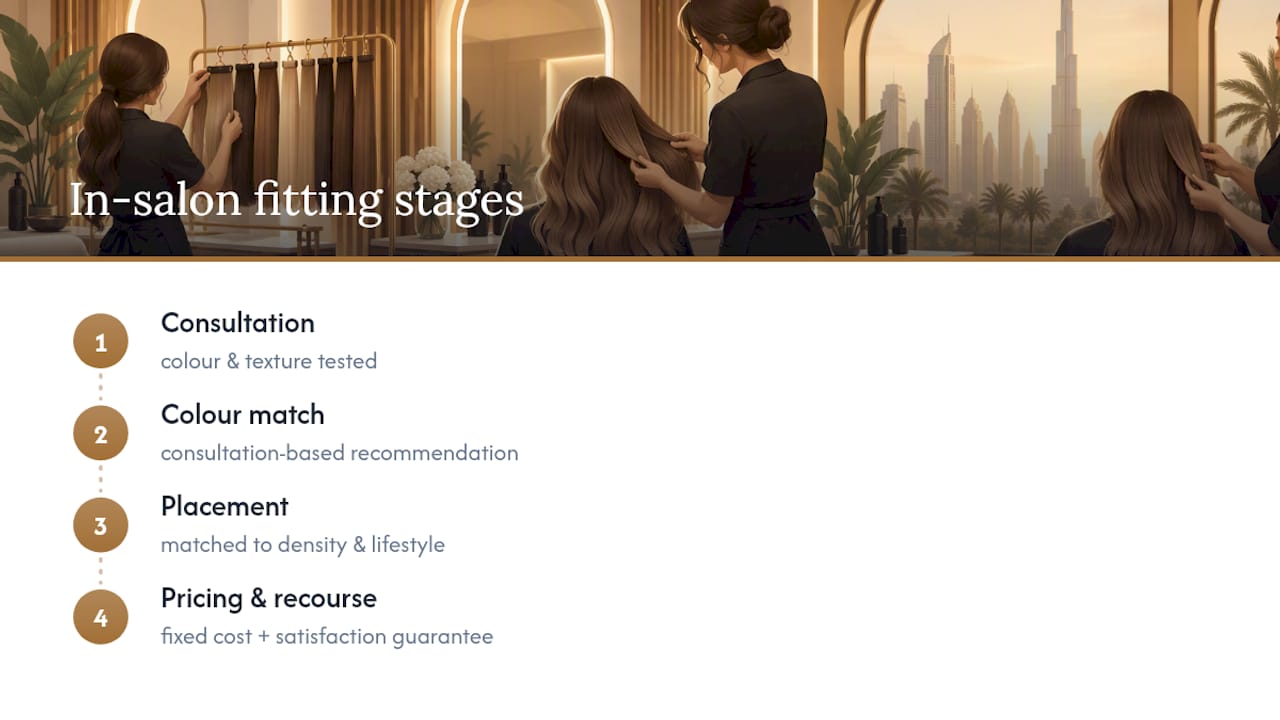
A proper in-salon fitting starts with consultation, not a shade card handed over the counter. Testing colour and texture against your actual hair, in person or by photo, before recommending a method or packet count is standard practice among specialist providers, and it is the step most DIY buyers skip.
A professional hair extension service typically includes consultation-based colour matching, placement suited to your density and lifestyle, and a professional cut and finish so the result blends into your natural style rather than sitting on top of it. Such services often carry fixed pricing and satisfaction guarantees, so you know the cost before you commit and have recourse if the blend does not sit right once you’re home.
Complex, multi-tonal colour, shorter hair with less length to disguise a join, or a sensitive scalp are the three situations where booking in-salon beats buying online and hoping for the best. A stylist can see your hair in daylight, under salon light, and styled, all in the same appointment.
The one mistake that ruins most blends
Matching extensions to your roots instead of your mid-lengths and ends is the mistake we see more than any other, and it is entirely avoidable. Roots are darker for a reason: regrowth, shadowing, less sun exposure. Match to that and your ends will look painfully obvious the moment light hits them.
The fix is straightforward. Test the shade against your ends in daylight, style your hair the way you normally wear it, then make the final call. Skip that order and you will likely be back in the chair within weeks asking for a redo.
— Boost
Book a blending consultation with Boost Beauty Lounge
Boost Beauty Lounge’s Hair Extension Package is built around the same principle covered throughout this guide: the method and the colour match decide whether extensions look expensive or obvious, and getting both right takes a proper consultation, not a guess. Your appointment includes colour matching against your mid-lengths and ends, a test placement to check density and comfort, and a professional cut and finish so everything moves as one.
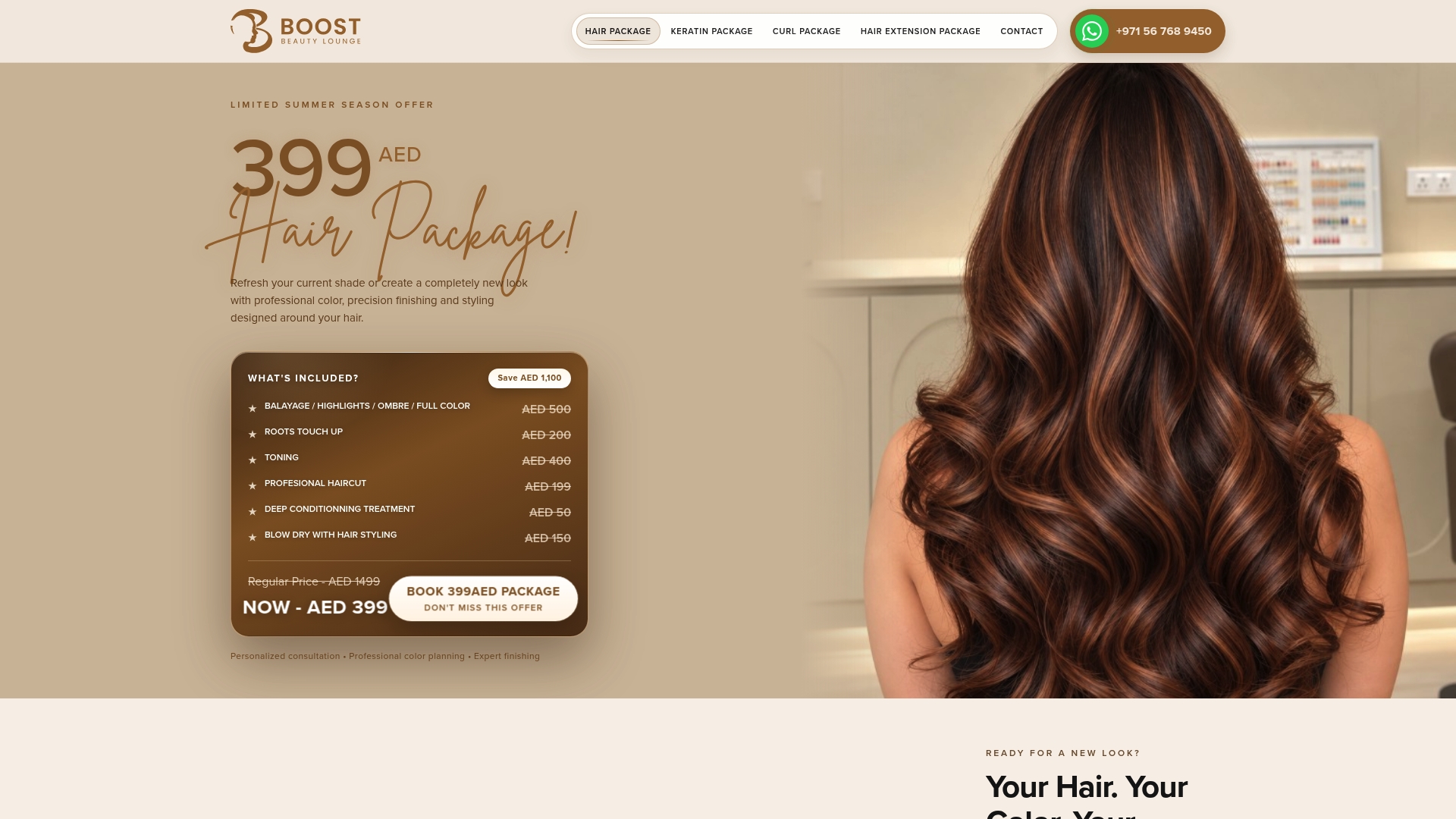
The package comes with fixed pricing and a 10 day satisfaction guarantee, and you pay only after the service is complete. For anyone with multi-tonal colour, shorter hair, or a scalp that’s sensitive to bonding, this beats ordering online and hoping the shade lands right. Boost Beauty Lounge is based in Deira, a minute from Salah Al Din Metro Exit 1, making it an easy stop before or after work.
Book your consultation for the Hair Extension Package through WhatsApp or by phone, and bring a photo of the shade you’re aiming for if you have one.
Sources
- Hair Extensions Manual • Beauty Academy (2025)
- Hair extensions: anatomic, biological, and clinical considerations • J Cutan Surg Oncol (2026)
- How to blend hair extensions for a natural look • Vixen & Blush
- How to blend hair extensions • PerfectLocks
- How to blend hair extensions with movement • American Salon
FAQ
How Long Does It Take Extensions to Look Fully Blended?
A skilled fitting and cut should look blended immediately, since the finishing cut happens with extensions already in place. Any adjustment period is about you learning to style natural hair and extensions together, which usually takes a wash or two to feel routine.
What’s the Best Method for Fine Hair That Won’t Show?
Tape-ins tend to lie flattest and suit fine hair well, since the tape distributes weight across a wider section rather than pulling at single points. Micro-bead or nano options work too, provided placement avoids clustering near the hairline.
How Much Does a Professional Hair Extension Package Cost?
Boost Beauty Lounge’s Hair Extension Package is priced at 1499 AED, covering consultation, colour matching, placement and finishing cut. Pricing is fixed upfront, so there are no surprises once the fitting is done.
Can I Swim or Exercise Heavily With Extensions In?
Yes, though tape-ins and wefts generally cope better with sweat and chlorine than bonded methods, which can loosen with repeated moisture exposure. Rinse and dry thoroughly after swimming, and tie hair back loosely rather than in a tight, high ponytail.
When Should I Have Extensions Removed Rather Than Refitted?
Remove extensions early if you notice tenderness, redness, or shedding concentrated in one spot rather than spread evenly across the scalp. A six to eight week wear cycle followed by a short rest period is a sensible default for most bonded and taped methods.
Ready to book this look?
See this package