Hair Toner Without Guessing: Match the Formula to Your Lift Level

A hair toner is a colour depositing product applied after pre lightening, or on tired blonde and lightened hair, to neutralise unwanted warmth and refine the finished shade. Unlike dye, it does not meaningfully lift or darken your natural level. The rest of this guide explains the formats available, how to pick the right one and when booking a professional makes more sense than reaching for a box.
TL;DR:
- Match pigment to exposed warmth: violet cancels yellow at level 10, blue targets orange around levels 7 to 9, and green counters red on darker hair.
- If hair is repeatedly bleached or previously colored, its porosity can make toner grab too quickly, so test a hidden strand before applying it everywhere.
- Purple shampoo suits gradual upkeep, while masks offer stronger refreshes; schedule salon demi toner every four to eight weeks as warmth returns.
- Choose a professional correction for uneven color, repeated chemical services, or a failed home attempt; another box toner can worsen patchiness.
Table of Contents
- What a hair toner is and the product forms you might find
- How toners work: pigment, colour theory and demi versus semi
- Toner vs hair dye: what each one actually changes
- Choosing the right toner shade by lift level and hair condition
- Salon toning versus at-home toning: what to expect from each
- How often to tone, and how to make results last longer
- How a professional toning consultation works at Boost Beauty Lounge
- Why toning is the finishing touch that actually matters
- How we handle toning as part of your colour service
- FAQ
- Sources
What a hair toner is and the product forms you might find
Toner sits in a specific place in the colour process. It is not a replacement for permanent colour, and it is not quite the same as the purple shampoo sitting in your shower. A professional toner, as used after lightening, is a concentrated colour corrective designed to neutralise the yellow, orange or red tones that bleach exposes, and it is mixed to a client’s exact lift level and desired finish, which is why salon toners are more pigmented than maintenance purple shampoos.
That distinction matters because the toners you buy off a shelf and the ones mixed behind a colour bar are not doing identical jobs. A salon toner corrects a specific, freshly lightened result. A retail product generally maintains or softens a result that is already close to where you want it.
At home, you will usually come across a few different formats, each with its own strength and lifespan:
- Purple shampoo: a light wash in violet pigment that counteracts brassiness gradually, best used once or twice a week rather than as a single fix.
- Colour depositing mask: a leave in treatment with more concentrated pigment than shampoo, typically used every one to two weeks to refresh tone and add shine.
- At home gloss or toner kit: a stronger, semi permanent formula applied for a set processing time, closer to a salon result but without professional mixing or strand testing.
Many current formulas also build in conditioning agents or bond building ingredients, which is a shift from older toning products that focused purely on pigment. These additives are included to offset the dryness that comes with repeated lightening and toning, and some modern toner and gloss formulas now include bond building or conditioning ingredients specifically to reduce the look and feel of damage while extending how long the colour stays vibrant.
If you are dealing with warmth on brunette or darker lengths rather than classic blonde brassiness, the logic is similar but the pigment choice differs, which we cover in more detail in our piece on toning brunette hair.
How toners work: pigment, colour theory and demi versus semi
To understand why a toner works, it helps to understand what bleach actually does to your hair. Lightening strips natural pigment in stages, and at each stage it exposes an underlying warmth, often called the contributing pigment, that was always there beneath your natural colour. Pale yellow typically shows up at the lightest stages, with orange and red appearing at the mid lift levels. A toner is chosen specifically to cancel that exposed tone.
The logic follows basic colour theory, and once you see the pattern it is easy to apply:
- Violet neutralises yellow, which is why pale blonde and lightened grey hair usually gets a violet based toner.
- Blue neutralises orange, the warmth that tends to show at mid lightening stages.
- Green neutralises red, which is the tone that often needs correcting on darker, less lightened hair or on brunette bases.
This mapping comes directly from how colourists assess a head of hair before mixing anything, choosing a toner based on the contributing pigment exposed by bleaching, where violet is used against pale yellow at level 10, blue against orange, and green against red.
The second piece of the puzzle is formula type. Demi permanent and semi permanent toners behave differently, and the difference affects both how long your result lasts and how your hair feels afterwards. Semi permanent formulas coat the hair shaft without a developer and wash out gradually over a few shampoos. Demi permanent formulas use a low volume developer to deposit pigment slightly into the outer shaft, which is why demi permanent formulas deposit pigment into the outer hair shaft with conditioning benefits and typically last longer than simple semi permanent surface tints.
A significant proportion of at home toning attempts run into trouble when the person applying it has not correctly judged their current lift level or porosity first, according to professional guidance from L’Oréal Professionnel, which flags misjudged starting points as a common cause of toning problems at home. Porosity changes how fast hair absorbs pigment, and a stronger developer on already porous, over processed hair can grab too much colour, too fast, which is one reason colourists test a strand before committing to a full application.
Toner vs hair dye: what each one actually changes
Confusing toner with dye is probably the most common mix up in this part of hair colour, so it is worth being precise about what each product is built to do.
Permanent hair dye uses ammonia and a developer to open the hair cuticle, lift your natural level and deposit new, lasting pigment, which is also how it covers grey. It changes your actual colour, not just the tone sitting on top of it. A toner does not lift level in any meaningful way. It adjusts the tone of colour that is already there, whether that colour came from bleach, from a previous dye job, or simply from sun fading.
In practice, that means the two products solve different problems, and mixing them up leads to disappointment on both sides:
- Choose dye when you want to go noticeably lighter or darker, or when you need full grey coverage.
- Choose a toner when your base colour is right but the tone looks brassy, yellow, or flat.
- Use both together after a lightening service, since bleach almost always needs a toner afterwards to look finished rather than raw.
- Consider a demi permanent toner as a low commitment option if you want a tonal change without the lasting result of permanent dye, since demi formulas fade out gradually rather than growing out at the root.
This last point is where toner and colour genuinely overlap. A demi permanent service can refresh a dull all over colour, soften regrowth lines, or shift ash tones warmer and back again, all without the long term commitment of a permanent formula. If you are weighing up a full colour correction rather than a simple tone refresh, our breakdown of DIY versus professional colour correction goes into when each route makes sense.
Choosing the right toner shade by lift level and hair condition
Matching a toner to your hair comes down to two things: what level your hair has actually lifted to, and what tone you want to end up with. Guessing the wrong family of toner is the single biggest reason at home results go wrong.
A simple way to think about it, working from lightest to darkest:
- Level 10 (palest blonde): a violet based toner, since the contributing pigment at this stage is pale yellow.
- Level 8 to 9 (light to medium blonde): a violet and blue hybrid, which handles the mix of yellow and orange typically still present.
- Level 7 to 8 (medium to darker blonde): a blue based toner to cancel the stronger orange warmth at this stage.
- Darker blondes and brunettes: a green based toner to control red tones, or a tinted gloss where the goal is depth and shine rather than a strong colour correction.
Porosity and chemical history change how this plays out in practice. Hair that has been bleached multiple times, or that has had previous colour services, tends to be more porous and will often grab toner faster and more intensely than virgin hair at the same level. That is exactly the kind of variable that professional guidance warns home colourists to check before toning, since the same product can behave quite differently on two heads that look similar before application.
If your colour and tone are already close to right and you simply want more shine, a clear gloss or acid gloss is worth considering instead of a pigmented toner. These seal the cuticle and add reflective shine without shifting tone, which is useful maintenance between colour appointments. We go into how long these treatments typically last in our guide to gloss treatments and their longevity.
Pro Tip: Always strand test a new toner on a small, hidden section first, especially if your hair has been chemically treated more than once, since porosity can change the result far more than the product label suggests.

Salon toning versus at-home toning: what to expect from each
Both routes can work, but they solve the problem at different levels of precision, and it helps to know what you are trading off before you choose one.
A colourist mixing toner in a salon is working with your hair in front of them. They can judge your actual lift level, test a strand, adjust developer strength, and stop processing at exactly the right moment, something no packaged product can do for you. They are also adjusting the formula in real time if your hair is absorbing colour faster or slower than expected, which is the main reason salon results tend to look more even and more precisely toned than home attempts.
At home, you are working with a fixed formula and a best guess at timing. The common options and their realistic limits:
- Purple shampoo: good for gradual upkeep between appointments, but too mild to correct strong brassiness on its own.
- Colour depositing masks: stronger than shampoo and useful for a quick refresh, though results fade within a couple of weeks.
- Boxed or kit toners: closer to a salon result in strength, but with no professional strand test and a higher risk of over toning or patchy coverage, particularly on hair with mixed porosity.
A professional correction is generally the safer route when your hair has an uneven base, a history of multiple chemical services, or when a previous at home toning attempt has already gone wrong, since at home options are less custom and less pigmented than salon toners, and getting the shade and processing time right matters to avoid unwanted results. Trying to fix an uneven toning job with another box product at home often compounds the problem rather than solving it.
How often to tone, and how to make results last longer
Toner is not permanent, which is exactly what makes it useful for adjusting tone without a long term commitment, but it also means the schedule matters if you want consistent colour.
A practical maintenance routine looks roughly like this:
- Book a salon demi toner refresh every four to eight weeks, since this is the typical window before warmth starts creeping back in on most lightened or blonde hair.
- Use a purple or blue shampoo once or twice a week between appointments, depending on how quickly your hair pulls warm, to slow brassiness rather than eliminate it outright.
- Add a colour depositing mask every one to two weeks if your tone fades faster than your shampoo routine can manage on its own.
- Switch to a colour safe, sulphate free shampoo and conditioner to protect the toner from stripping out prematurely.
- Keep heat styling low and use UV protection on hair that sees regular sun, since both heat and sun exposure accelerate tonal fading.
A quick at home refresh, such as a ten minute colour depositing mask on damp hair, can buy you another week or two of true tone between salon visits. The point to stop and book a stylist instead is when the brassiness comes back faster than a mask can manage, or when regrowth and faded ends start creating two different tones on the same head. At that stage, a professional refresh resets the whole look rather than patching one section. Our piece on short balayage and its typical refresh cadence shows how this plays out on a real colour service.
How a professional toning consultation works at Boost Beauty Lounge
When a client comes in for toning, we start with a consultation rather than a guess. We look at your natural level, any previous colour or lightening services, how porous your hair currently is, and the tone you are actually trying to reach, since those four factors determine which toner family and which developer strength will work on your hair specifically.
From there, the in salon step typically involves mixing a demi permanent toner matched to your lift level, choosing a developer strength appropriate to your hair’s current condition, and finishing with a conditioning gloss where shine needs a boost alongside the tone correction. We time the process carefully rather than leaving it to a fixed instruction on a box, which is the main advantage of having a colourist monitor the result as it develops.
Every colour service we offer, including toning, comes with a few practical reassurances. Our packages are priced transparently from the outset, we talk through home care products and routines before you leave, and every service carries a satisfaction guarantee. We are also easy to reach for a follow up appointment.
Why toning is the finishing touch that actually matters
Most of the attention in a colour transformation goes to the lightening or the dye, but toning is usually the step that decides whether the final result looks professional or simply looks bleached. A lift without a proper tone correction can look raw and uneven, even when the level itself is exactly right.
What people tend to underestimate is how much tone affects the perception of hair health. Hair that is correctly toned reads as glossy and deliberate, while the same hair with leftover brassiness reads as damaged, even when the condition underneath is identical. That gap between what lightening promises and what actually makes it look finished is almost entirely down to toning.
If you have invested in lightening, grey coverage or balayage, treat toning as part of that investment rather than an optional extra. Whether that means a weekly purple shampoo habit or a standing salon appointment every few weeks, the finishing step is where the result actually comes together.
— Boost
How we handle toning as part of your colour service
Toning is not something we treat as an afterthought. It is built into how we plan every colour transformation from the first consultation, because a lift without the right tone correction rarely looks finished.
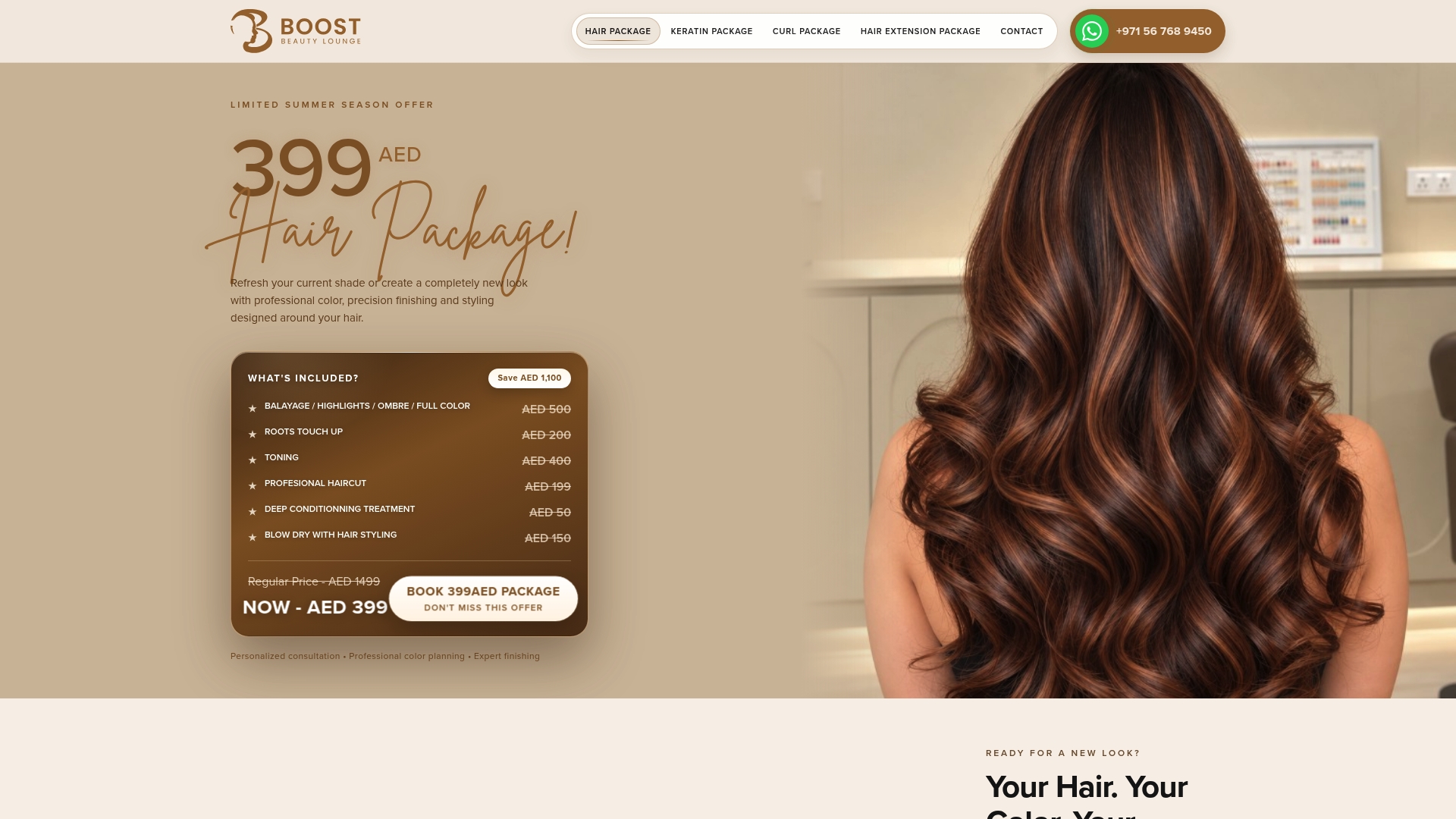
Our Hair Package, with a published price of 1499 AED, covers balayage, highlights, ombre or full colour alongside the supporting services that actually make the colour look complete, including roots touch up, toning, haircut, deep conditioning, blow dry and styling. We plan the colour and tone together during your consultation, so the toner you leave with is matched to your actual lift level rather than applied as a generic step at the end.
What to expect at an appointment:
- A consultation covering your natural level, previous services and the tone you want to reach.
- Transparent, fixed pricing agreed before we start, with payment only after the service is completed.
- Home care guidance so your toner lasts as long as possible between visits.
- A 10 day satisfaction guarantee on the finished result.
If you want to see current pricing and book, visit our hair package booking page or reach us directly through WhatsApp or phone, both listed on the booking page. We are based in Deira, a minute from Salah Al Din Metro Exit 1, for anyone who wants to combine the appointment with a metro commute. You can also check directions to the salon before your visit.
FAQ
What does a toner do for hair?
A toner neutralises unwanted warm or brassy tones left after lightening and refines the hair into a cleaner, more polished final shade. It adjusts tone rather than changing your underlying level, and salon toners are more pigmented than the purple shampoo you would use for maintenance.
What is the best toner to use after bleaching my hair?
The right toner depends on how light your hair has lifted: a violet based toner suits the palest blonde levels, a blue based toner suits mid level warmth, and a green based toner handles red tones on darker, less lightened hair. This follows the standard colour theory colourists use, where violet cancels yellow, blue cancels orange and green cancels red.
How to tone bleached hair at home?
At home toning usually means a purple shampoo for gradual upkeep, a colour depositing mask for a stronger short term refresh, or a boxed semi permanent toner for a closer to salon result. Assess your current lift level and porosity honestly before choosing a product, since misjudging these is a common reason home toning goes wrong.
What are the different colours of hair toners available?
Toners come in violet, blue and green bases, each matched to a specific unwanted tone: violet for yellow, blue for orange and green for red. Clear or acid glosses are also available when the goal is shine rather than a tonal correction.
Can I book a professional toning service instead of doing it at home?
Yes, a colourist can assess your hair in person, mix a toner to your exact lift level and monitor processing time, which tends to produce a more even result than a fixed home formula. Our Hair Package includes toning as part of the colour service, with fixed pricing and a 10 day satisfaction guarantee.
Sources
- All you need to know about hair toner - L’Oréal Professionnel
- What is demi‑permanent hair colour? | Wella Professionals
Recommended
Ready to book this look?
See this package