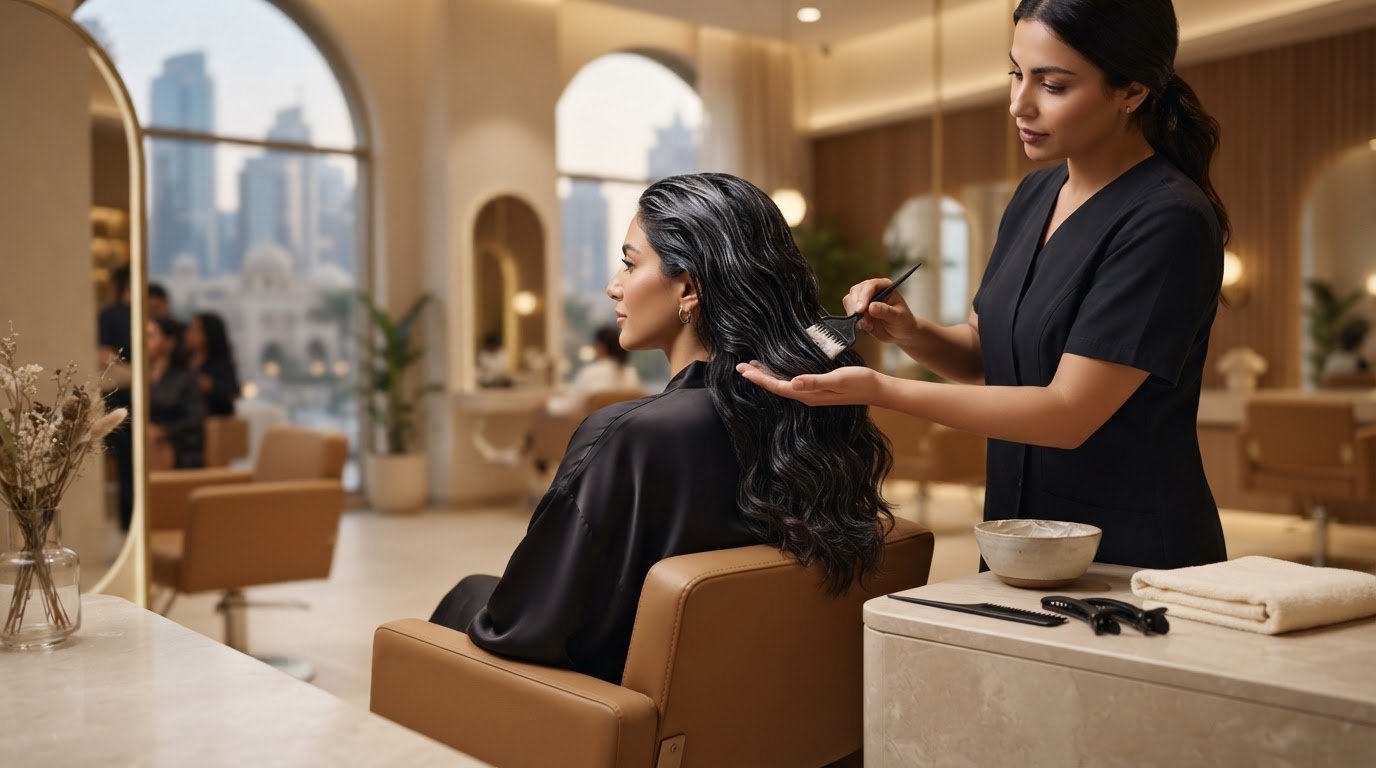
Salon First: DIY vs Pro Hair Color Correction in Dubai

If your colour has gone orange, patchy or too dark, the first question is whether you need a professional colour correction or just a gentle toner. Mild brass after highlights usually responds to a purple or blue toner at home. Anything involving uneven lift, banding or a big tonal jump needs a salon consultation, not a DIY chemical fix.
TL;DR:
- DIY solutions are suitable only for mild brassiness or subtle tone shifts, while complex issues like banding or damage require a professional correction.
- Proper correction involves diagnosis, strand testing, staged lifting, and careful toning to prevent further damage and achieve a balanced final shade.
- Neutralizing brassiness depends on opposing tones, but toner cannot brighten unlifted hair or fully fix severe unevenness.
- Hair porosity and health influence how correction products react, making bond-rebuilding treatments essential for minimizing damage during multiple sessions.
- Costs vary based on hair length, previous colour history, and correction complexity, with staged work typically better for hair preservation.
Table of Contents
- Quick decision checklist: when to DIY and when to book a salon correction
- Step-by-step colour correction process a stylist follows
- Troubleshooting common problems: brassy/orange, too dark, patchy or striping
- Toner explained: what it does, what it won’t do, and how long it lasts
- Hair health, developer strength and porosity: reducing damage during correction
- Timeline and cost expectations for colour correction
- Aftercare and maintenance to keep corrected colour looking its best
- Potential allergic reactions and patch test importance before colour correction
- Impact of natural hair colour on correction strategies
- Tips for communicating desired results effectively with a hairstylist
- Possible alternatives to full colour correction
- Why staged, conservative correction wins over quick fixes
- How Boost Beauty Lounge approaches colour correction
- Sources
- FAQ
Quick decision checklist: when to DIY and when to book a salon correction
Some colour problems are cosmetic and shallow. Others sit in the hair’s structure and need a trained eye before anything touches the strands again.
Book a salon visit if you notice uneven lift, visible banding, a jump from very dark to very light, obvious damage (snapping, gumminess, excessive shedding) or a history of multiple previous dyes layered on top of each other. These situations often need staged correction, not a single fix.
A home fix is reasonable for mild brass or a single tone drifting warm, such as blonde turning slightly yellow. A purple shampoo or gentle toner usually settles this within one or two washes.
Before any salon visit, prepare:
- Photos of your hair in natural light, front and back.
- A written timeline of your last three to four colour services, including brands if known.
- A list of any products used at home, including box dyes or toning kits.
- Notes on any scalp sensitivity, allergic reactions or patch test history.
Step-by-step colour correction process a stylist follows
A proper correction starts with diagnosis, not product. A stylist checks porosity, examines your colour history and often runs a strand test before touching the rest of your head.
- Consultation and strand test: the stylist takes a small section and tests how it reacts to lightener or toner before committing the whole head.
- Porosity and damage check: they assess how open the hair cuticle is, since porous hair lifts faster and grabs toner differently.
- Decision on approach: tone-only correction if the base is close to right, darkening if the colour is too light, or staged lifting if brassy pigment needs removing gradually.
- Staged lift with treatment breaks: where bleach is needed, it’s applied in controlled stages with bond-building treatments between sessions rather than one aggressive pass.
- Re-toning and blending: once the base tone is even, a toner or gloss refines the final shade and blends any remaining warmth.
Salons typically favour lower-strength developers and colour remapping (adjusting placement rather than blanket-bleaching) to avoid overworking hair that’s already compromised. According to Wella Professional’s guidance on colour correction, strand tests and porosity checks determine how hair will react to lightening and whether bond-rebuilding treatments are needed between sessions.
Pro Tip: Bring a photo of the exact result you want, not just a word like “ashy” or “warm”, since tone words mean different things to different people.
Troubleshooting common problems: brassy/orange, too dark, patchy or striping
Each common colour complaint has a different fix, and mixing them up wastes time and risks damage.
- Brassy or orange after bleaching: neutralise with an opposing tone (blue cancels orange, purple cancels yellow), but understand that toner only adjusts tone, it won’t lift hair that hasn’t been bleached enough. HairTerms explains that toner neutralises unwanted warmth after lightening but can’t reliably create brightness on hair that hasn’t been lifted enough.
- Too dark: options include a colour remover, a gentle lightening pass, or simply re-dyeing to a shade compatible with what’s underneath rather than trying to strip everything back to a lighter base.
- Patchy results or banding: this usually needs colour remapping, where a stylist blends harsh lines section by section rather than reapplying one flat colour over the top.
- When patch fixes backfire: repeating a full-strength bleach application over already-processed hair to “fix” a patch often worsens breakage instead of solving the unevenness.
Staged correction exists precisely because these problems rarely have a one-step answer. A stylist working through banding or patchiness will often need more than one visit to blend safely.
Toner explained: what it does, what it won’t do, and how long it lasts
Toner is a finishing step, not a lightening step. It neutralises unwanted warmth and adds shine and polish once the base colour is already close to right.
What toner cannot do is create brightness on hair that hasn’t been lifted enough, a point HairTerms makes clear in its breakdown of the term. Think of it as tone control, not brightness control.
- Toner typically lasts for several weeks before it needs refreshing.
- Cooler or ashier tones tend to fade faster than warm or neutral ones.
- Tell your stylist your “fade preference”: do you want it to fade warm, ashy, or stay neutral as long as possible?
- Salon toning gives more precise, longer-lasting results than at-home box toners because the formula is mixed for your exact base.
Hair health, developer strength and porosity: reducing damage during correction
The biggest risk in any correction isn’t the toner, it’s the lightening step. Nazih’s guidance on hair developers recommends avoiding aggressive developer strengths for correction work, with many salons favouring 10 to 20 volume over very high volumes, paired with staged sessions rather than one aggressive pass.
Porosity testing matters because porous hair lifts faster and processes chemistry differently, which changes both timing and product choice. Bond-rebuilding treatments, both in-salon and take-home, help hold the hair’s internal structure together between lightening sessions.
Pro Tip: If hair starts feeling gummy, stringy or unusually stretchy during a lift, that’s a sign of protein breakdown. Stop, treat, and reassess before continuing.

A conservative approach protects the hair long-term: you can always add more colour later, but you cannot reverse structural damage from over-bleaching.
Timeline and cost expectations for colour correction
Some corrections finish in a single session lasting a few hours. Others, particularly staged lifts on heavily coloured hair, need multiple sessions spread over several weeks with treatment breaks in between.
Cost is driven by hair length, how much previous colour has to be worked around, the amount of lift needed and any added treatments like bond repair or toning. Longer, darker or more heavily processed hair generally takes more time and more product.
When booking, ask for a clear quote upfront and check whether the salon offers a satisfaction guarantee, since correction work sometimes needs a follow-up visit to get the tone exactly right.
Aftercare and maintenance to keep corrected colour looking its best
Corrected colour needs gentler handling than colour that hasn’t been through a correction process.
- Use sulfate-free, colour-safe shampoo and conditioner to slow fading.
- Rinse with cool water where possible, since heat opens the cuticle and pushes colour out faster.
- Use a heat protectant before styling tools and reduce wash frequency if the colour is fading quickly.
- Book a toner refresh every few weeks depending on how fast your particular tone fades.
Discuss your fade preference at each visit. A stylist adjusting toner slightly warmer or cooler each time keeps the colour looking intentional rather than tired.
Potential allergic reactions and patch test importance before colour correction
Colour correction often involves stronger or more frequent chemical exposure than a standard dye job, which makes a patch test worth taking seriously rather than skipping.
A patch test involves applying a small amount of the product (or a comparable formula) to a small area of skin, usually behind the ear or on the inner elbow, and waiting 48 hours to check for redness, itching, swelling or blistering. This matters more during correction work because multiple products, toners, lighteners and colour depositors, may all touch the scalp and hairline in one appointment.
If you have never reacted to hair colour before, that doesn’t guarantee you won’t this time. Sensitivity can develop after repeated exposure to certain dye ingredients, so a patch test is worth doing before every new correction, not just the first one.
Tell your stylist about any history of scalp irritation, eczema or previous reactions before they begin. A salon working from a consultation will usually ask about this directly, and flagging it yourself avoids delays or last-minute changes to the plan once you’re already in the chair.
Impact of natural hair colour on correction strategies
Your natural base colour shapes almost every decision in a correction, because it’s what the hair reverts to as artificial colour lifts or fades.
Naturally dark hair holds underlying warm pigment (red and orange tones) that becomes visible as colour is lightened, which is why brassiness is such a common complaint during correction. Naturally fair or light brown hair tends to lift with less underlying warmth, so corrections often move faster and need less toning to neutralise unwanted tones.
If you have grey or white strands mixed through your natural colour, they often behave differently under lightener and toner than pigmented hair does, sometimes taking colour unevenly compared with the rest of the head. A stylist accounts for this by treating grey sections separately during the plan.
Knowing your natural base also helps set realistic expectations. Someone with naturally black hair aiming for a pale blonde correction is working against more underlying pigment than someone starting from mid-brown, which is one reason the same “target shade” can need very different numbers of sessions for different people.
Tips for communicating desired results effectively with a hairstylist
The gap between what you picture and what a stylist delivers usually comes down to vocabulary, not skill.
Bring two or three reference photos rather than one, ideally showing the tone, the placement of lightness or darkness, and how it looks in different lighting. Photos remove the guesswork that comes with words like “warm” or “ashy”, which mean different things to different people.
Be specific about what you don’t want as well as what you do. Saying “not too yellow” or “not too cool” gives a stylist a boundary to work within, which is often more useful than a single target shade.
Mention your maintenance habits honestly, including how often you’re willing to come in for toner refreshes and how much time you spend on styling at home. This shapes whether a stylist recommends a low-maintenance blend or a more precise tone that needs regular upkeep.
Finally, ask what the plan looks like before it starts: how many sessions, what each one involves, and what the in-between look might be if you’re mid-correction. A stylist working from a proper consultation should be able to answer all of this before any product touches your hair.
Possible alternatives to full colour correction
Not every colour complaint needs a full correction. Several lighter-touch options can solve the problem without the time or cost of a staged lift.
Colour blending, sometimes called colour melting, softens harsh lines or regrowth without lifting or removing existing colour, making it a good option for mild banding rather than severe unevenness. A gloss treatment adds shine and a light tonal shift, similar to a toner but often with a bit more depth, and works well when the base colour is close to right but looks a little flat or dull.
For brassiness alone, a toner refresh may be all that’s needed rather than a full correction appointment. And where damage is the main concern rather than tone, a bond-building treatment paired with a trim can sometimes improve how the existing colour looks without any further chemical processing.

These alternatives work best when the underlying colour is reasonably close to the target. Once there’s real unevenness, heavy banding or a large tonal gap, these lighter fixes tend to mask the problem rather than solve it.
Why staged, conservative correction wins over quick fixes
The biggest mistake I see is treating correction like a single dramatic appointment. Staged work with treatment breaks protects hair long-term, and consultation-based pricing with a guarantee removes the guesswork. Bring references, state your fade preference clearly, and let the plan unfold over the sessions it actually needs.
— Boost
How Boost Beauty Lounge approaches colour correction
If your colour needs professional attention, Boost Beauty Lounge’s hair package gives you a fixed price rather than an open-ended bill. The AED 399 package includes a consultation, roots touch-up, toning, haircut, deep conditioning, blow-dry and styling, all planned around your hair’s actual condition rather than a one-size approach.

- Consultation-based planning before any chemical work begins.
- Payment only after the service is completed, not upfront.
- A 10-day satisfaction guarantee if the result needs adjusting.
- Located one minute from Salah Al Din Metro Exit 1 for easy access.
If your correction involves significant damage or needs bond repair alongside colour work, the keratin and protein package can be discussed at consultation too. For anything beyond mild brass or a single-tone drift, book a consultation with Boost Beauty Lounge over WhatsApp or phone rather than attempting a strong chemical fix at home.
Sources
- Nazih — Hair developer guidance
- HairTerms — Toner (what it does, when you need it)
- Wella Professional blog — colour correction techniques
FAQ
How much does a colour correction cost?
Cost depends on hair length, previous colour history and how much lift is needed, so prices vary widely between salons. Ask for a clear quote at consultation before committing, and check whether a satisfaction guarantee is included.
How long does a colour correction last?
The base correction itself can last as long as any colour service, but toning on top typically fades within weeks rather than months. Cooler tones fade faster than warm ones, so plan for periodic toner refreshes to maintain the look.
Is colour correction damaging to hair?
The main risk comes from the lightening step, not the toning step, which is why staged sessions with lower-strength developers and bond-building treatments between lifts are favoured over one aggressive pass. Watch for gummy or stringy texture during processing, as this signals it’s time to stop and reassess.
What is the best colour correction approach?
There is no single best method, since the right approach depends on your natural base colour, previous colour history and how much unevenness needs fixing. A consultation with strand testing and porosity checks is the most reliable way to determine whether you need tone-only correction, darkening or a staged lift.
Ready to book this look?
See this package