What if the richest mask isn’t the right fix for your hair? In Dubai, heat, humidity, dust, and indoor air conditioning can leave strands feeling dry, rough, tangled, or difficult to manage. This deep conditioning hair treatment Dubai guide starts with a practical point: choose care for your hair’s needs rather than assuming more product will work better.
Deep conditioning may improve softness, smoothness, and manageability, but it won’t permanently repair damage or replace care suited to your hair type and scalp. The right product and routine matter.
Here, you’ll learn how deep conditioning works, how to apply a mask, and how to follow its directions without overdoing it. You’ll also find tips for choosing at-home care, deciding when to ask a stylist about professional options, and knowing when a scalp concern needs a different kind of advice. If you’re looking for a local women’s salon, Boost Beauty Lounge in Deira offers professional hair treatments including keratin, protein, and hair Botox.
Key Takeaways
- A deep conditioning hair treatment Dubai routine works best when it addresses your hair’s needs, rather than relying on guesswork.
- Learn how moisture-focused conditioning differs from protein-focused care, and what to ask before trying either.
- A mask may improve softness and manageability, but it can’t restore damaged ends to their original condition.
- Follow the product’s directions for application and rinse time. Formulas don’t all work the same way.
- If home products aren’t giving you the feel you want, discuss your hair history, goals, and aftercare with a stylist.
What a Deep Conditioning Hair Treatment in Dubai Can Do
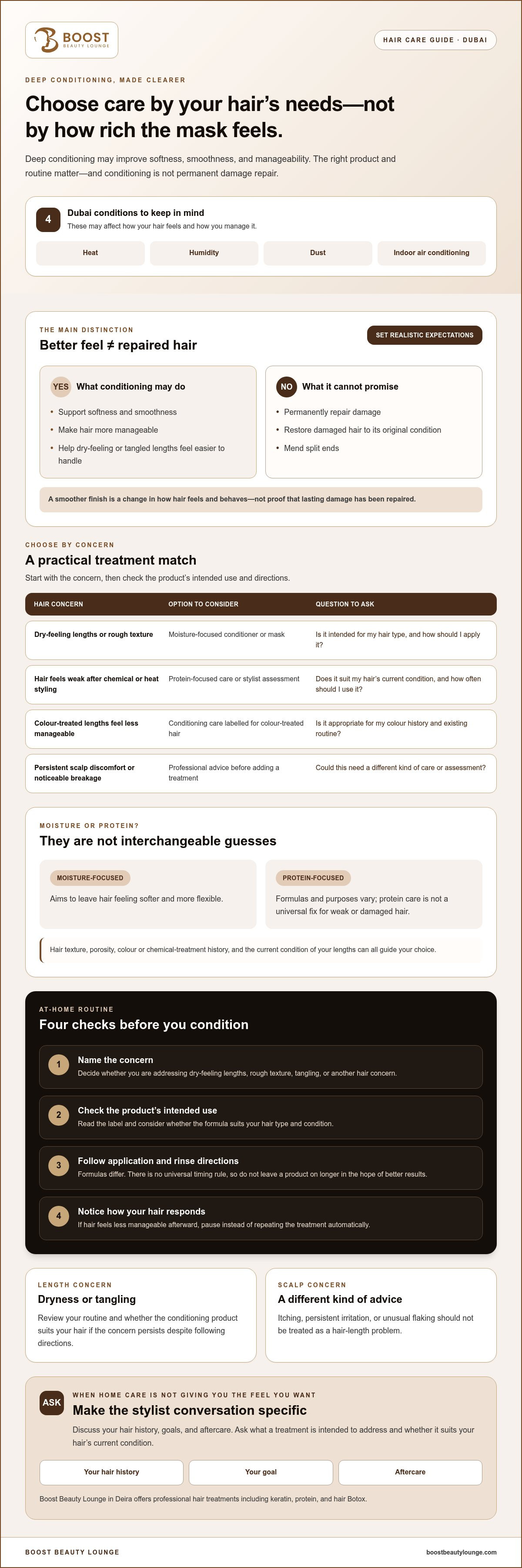
A deep conditioning treatment uses products that coat the hair and, in some cases, penetrate the hair fibre to support softness and manageability. It may be worth trying if your lengths feel dry, rough, or prone to tangling, or if colour-treated hair feels harder to manage. The finish depends on the formula and your hair. Conditioning is cosmetic care, not a guaranteed repair procedure: it won’t permanently mend split ends or restore damaged hair to its original state.
Dubai’s heat, humidity, dust, and shifts between outdoor conditions and indoor air conditioning may affect how your hair feels and how you manage it. But a change in texture doesn’t automatically call for a richer mask. Consider your hair’s condition, styling habits, and scalp needs before choosing a product. Understanding what hair conditioner is can help clarify how conditioning products are intended to improve hair’s feel and handling.
How deep conditioning differs from everyday conditioner
Everyday conditioner is generally designed for regular use after shampooing, while a deep conditioning product is a more targeted step. Formulas and directions vary, including how long a product should stay on your hair. There’s no universal timing rule: follow the label rather than leaving a product on longer in the hope of better results.
Think of deep conditioning as a focused way to support softness and manageability, not a promise of structural repair. The name alone doesn’t explain exactly how a formula will perform. Check its directions and intended use, and consider whether it suits your hair.
Which hair concerns may benefit from conditioning?
Dry or rough lengths may feel softer after conditioning, while tangled hair may become easier to comb or style. Colour-treated lengths can also feel dry or less manageable, though a mask won’t reverse colour or chemical damage. Identify where the concern is: dry-feeling lengths may respond to conditioning, but scalp itching, persistent irritation, or unusual flaking calls for a different approach. Don’t treat a scalp concern as a hair-length problem.
Realistic expectation: Deep conditioning may improve how hair feels and behaves, but a smoother finish doesn’t prove that lasting damage has been repaired. If dryness or tangling persists despite following the directions, review your routine and whether the product suits your hair.
How to Choose a Deep Conditioning Treatment for Your Hair
Start with the concern you want to address, then check whether the product or service is intended for it. Hair texture, porosity, colour history, and current condition can all affect how a formula feels and performs. A deep conditioning hair treatment Dubai option isn’t automatically right because it promises moisture or repair. Compare the intended use, read the label, and ask questions before applying a new product or choosing a salon treatment.
| Concern | Product or service type to consider | What to ask before use |
|---|---|---|
| Dry-feeling lengths or rough texture | Moisture-focused conditioner or mask | Is it intended for my hair type, and how should I apply it? |
| Hair feels weak after chemical or heat styling | Protein-focused care or stylist assessment | Does this suit my hair’s current condition, and how often should I use it? |
| Colour-treated lengths feel less manageable | Conditioning care labelled as suitable for colour-treated hair | Is it appropriate for my colour history and existing routine? |
| Persistent scalp discomfort or noticeable breakage | Professional advice before adding a treatment | Could this need a different kind of care or assessment? |
Moisture-focused care versus protein-focused care
Moisture-focused products aim to leave hair feeling softer and more flexible. Protein products vary in formula and purpose, so don’t assume they’re a universal fix for weak or damaged hair. Follow the product’s directions and notice how your hair responds. If it feels less manageable afterward, pause instead of repeating the treatment automatically.
Your curl pattern is only one factor. Porosity, colour or chemical-treatment history, and the condition of your lengths can also guide your choice. For background on how hair damage repair works, see Medical News Today. If curls are a key concern, compare options in this guide to choosing curly hair treatment packages.
What to ask before choosing a salon treatment
Be specific about your goal: softer-feeling lengths, easier detangling, or help understanding breakage. Ask what the treatment is intended to address and what result is realistic. Share your colour and chemical-treatment history, heat-styling habits, and home-care routine. Boost Beauty Lounge in Deira offers professional hair treatments, including keratin, protein, and hair Botox. Ask the salon which options may suit your needs. For persistent scalp discomfort, seek advice from a healthcare professional, and ask a stylist about significant breakage before trying another product.
Does Deep Conditioning Truly Repair Hair or Just Make It Feel Better?
A smoother finish can feel like a dramatic turnaround, but it doesn’t necessarily mean damaged hair has been permanently repaired. Conditioning can temporarily improve softness, reduce friction, make detangling easier, and help hair look more polished. These cosmetic changes can make everyday styling easier, but they’re different from restoring the hair’s original structure.
A mask can’t fuse split ends back together or return severely damaged lengths to their previous condition. A deep conditioning hair treatment Dubai routine may help hair feel more comfortable to handle, but softness alone isn’t proof of repair. The effect depends on the product, how it’s applied, your hair’s condition, and the care that follows. A more manageable feel is useful, but it doesn’t mean damage has disappeared.
What a conditioning treatment can realistically change
After conditioning, your lengths may feel softer, catch less during combing, or look smoother. Results vary between people and formulas. Application matters, too: following the directions is more reliable than leaving a product on longer or using it more often in the hope of a stronger result.
Conditioning can improve hair’s feel and appearance, but it doesn’t promise permanent structural repair. Keep this in mind when a product uses words such as “repair” or “restoring.” Check the directions and intended use, then assess how your hair behaves over time, not only how it feels immediately after rinsing.
When conditioning may not be enough
If breakage persists, chemical damage is substantial, or your concerns don’t improve with careful home care, pause before adding more products. A stylist can consider your hair history and help you understand what care may be appropriate. Share any colouring, chemical treatments, or frequent heat styling so the discussion reflects your hair’s condition.
Split ends generally need trimming. Conditioning may make the ends feel smoother temporarily, but it won’t reconnect them. It can support a more manageable feel, yet it isn’t a substitute for removing splits when needed. For a wider view of options, read this professional guide to hair treatments for women. If you’re in Deira, Boost Beauty Lounge is a local women’s salon offering professional hair treatments. Ask which options may be appropriate if you’re unsure what your hair needs.
How to Deep Condition Hair at Home in Dubai
A simple routine makes conditioning easier to tailor to your hair, especially when outdoor humidity and dry indoor air leave curls feeling different from one day to the next. Use this deep conditioning hair treatment Dubai routine as a starting point, not a climate-proof fix. Let your hair’s response and the product label guide each step.
A simple application routine from wash to rinse
- Cleanse if needed. Shampoo first if there’s product buildup or your hair needs washing. Otherwise, follow your usual wash routine.
- Remove excess water. Gently squeeze or blot your hair so it’s damp, not dripping. This helps you apply the product without excess water diluting it.
- Apply as directed. Work in manageable sections and distribute the product evenly, focusing on lengths that feel dry or rough. Avoid the scalp unless the label specifically says to apply there.
- Follow the stated time. Leave the product on for the duration stated in its directions. Add heat or cover your hair only if the directions allow it.
- Rinse and assess. Rinse as instructed. Once your hair is dry and styled, notice whether it feels easier to detangle or manage.
How often should you deep condition?
There’s no single schedule for every curl pattern, product, or hair condition. Start with the product’s directions, then adjust based on how your hair feels and behaves. If it becomes heavy or coated, reconsider how often you use it or whether the formula suits your hair. For persistent concerns, ask a stylist before increasing use or adding more products.
Dubai routines can involve shifts between humid outdoor air and air-conditioned indoor spaces. Notice how your hair feels in both settings rather than expecting one treatment to prevent frizz or dryness in every condition. Conditioning may support a softer feel, but curl definition also depends on styling choices and how you handle your hair after washing. Explore this step-by-step curly hair cut and style guide for more on defined curls and everyday styling.
Keep notes on the product you used and how your hair felt after rinsing. This can help you identify which routine works for you. If you’re unsure what your hair needs, ask Boost Beauty Lounge about professional hair-care options from its team in Deira.
When to Ask a Dubai Hair Stylist About Deep Conditioning
Another mask may not be the answer if your hair keeps breaking, feels unusually rough despite careful home care, or reacts poorly to products you’ve tried. A stylist can consider your hair’s condition and history before discussing what to try next. That conversation may help distinguish a conditioning step from another type of treatment, instead of choosing by the product label alone.
Questions to bring to a hair consultation
Arrive with a clear goal and a few details about your routine. Ask what the stylist observes, what a recommended service is intended to do, and what upkeep may involve. Useful questions include:
- What do you notice about my hair’s condition, and what needs should I prioritise?
- Is the option you recommend conditioning, protein-focused, smoothing, or another type of treatment?
- What result is realistic in how my hair feels or behaves?
- Does this option suit my previous colouring, chemical treatments, or heat-styling history?
- What aftercare should I follow, and how can I tell whether the treatment is working for me?
Share what you’ve tried at home, what didn’t suit you, and whether you’re noticing breakage or a change in manageability. If you’re considering a deep conditioning hair treatment Dubai service, confirm what the appointment includes and whether it matches your goal. When the problem persists or you’re unsure whether your hair needs moisture-focused care, protein-focused care, or another approach, discussing your hair history with a stylist may be more useful than adding another product.
Find curl-specific guidance in Dubai
Curls can respond differently depending on their pattern, condition, colour history, and styling routine. A recommendation should account for your individual hair, not just the fact that it’s curly. Use this checklist for finding a curl specialist in Dubai to prepare for a focused conversation.
Boost Beauty Lounge is a women’s hair salon in Deira offering professional treatments, including keratin, protein, and hair Botox. A dedicated deep-conditioning appointment isn’t confirmed, so ask the salon which available hair-care options may suit your concerns. Explore Boost Beauty Lounge and ask about suitable options for your hair.
Build a Conditioning Routine That Works for Your Hair
The right deep conditioning hair treatment Dubai routine starts with your hair’s actual needs, not the richest mask on the shelf. Choose care based on your hair’s texture, condition, and treatment history. Follow product directions and adjust according to how your hair feels. Conditioning may support softness and easier detangling, but it can’t permanently repair split ends or restore severely damaged hair.
If home care isn’t helping, persistent breakage or uncertainty about your next step is a good reason to ask a stylist. Share your hair history and goals, and ask what results and aftercare you can realistically expect. Boost Beauty Lounge is a women’s hair salon in Deira, Dubai, offering professional hair treatments including keratin, protein, and hair Botox. Ask which available options may suit your needs.
Explore Boost Beauty Lounge and ask about professional hair-care options. A thoughtful routine and advice that fits your hair can help you work towards softer, more manageable lengths.
Frequently Asked Questions
What is a deep conditioning hair treatment?
A deep conditioning treatment uses a targeted hair-care product to help improve softness, smoothness, and manageability. It’s generally applied to the hair lengths, not the scalp, unless the product directions say otherwise. The result depends on the formula and your hair’s condition. Hair may feel softer or easier to detangle afterward, but conditioning isn’t a permanent fix for split ends or structural damage.
How often should I deep condition my hair in Dubai?
There’s no single schedule for every hair type, product, or routine. Follow the label’s directions and notice how your hair feels after each use. Dubai’s outdoor conditions and frequent indoor air conditioning may affect how your hair feels, but they don’t set a universal frequency. If dryness or breakage continues despite careful home care, ask a stylist for guidance before increasing use.
Can deep conditioning repair damaged hair permanently?
No. Deep conditioning may make hair feel softer and easier to manage, but it can’t permanently restore split ends or reverse every kind of damage. Results depend on the product and your hair’s condition. If you notice significant breakage or damage after colouring or chemical services, ask a stylist to assess your hair and explain realistic options before choosing another treatment.
Should I deep condition my hair before or after shampooing?
Many routines use a conditioning mask after shampooing, but product directions vary. Check the label first and follow its instructions for application amount, timing, and rinsing. Some products are designed for a different step in the wash routine. If you’re unsure which method suits your hair, ask your stylist. Don’t leave a product on longer than its directions advise.
Is deep conditioning suitable for curly hair?
It can be part of a curly-hair routine, but the right product and application depend on your hair’s condition, texture, and styling preferences. Follow the product directions, then assess whether your curls feel manageable afterward. If your hair feels heavy or the treatment doesn’t address your concern, ask a curl specialist for tailored guidance rather than automatically using more product or applying it more often.
Can deep conditioning make hair greasy or weigh it down?
Yes, some hair may feel coated or heavy if a product doesn’t suit it, is overapplied, or isn’t rinsed as directed. Use the recommended amount and focus on the lengths that need conditioning. Fine hair or a scalp that becomes oily quickly may need a different approach. If the heavy feeling persists, review your product choice and application with a stylist.
What should I ask a stylist before booking a hair treatment in Dubai?
Explain your main concern and share your colour, chemical-treatment, and home-care history. Ask what the recommended service is designed to do, what results are realistic, and how to care for your hair afterward. Confirm whether the stylist means conditioning, protein-focused care, smoothing, or another treatment. Boost Beauty Lounge is a women’s hair salon in Deira offering professional hair treatments, including keratin, protein, and hair Botox.
Ready to book this look?
See this package