48 Hour Hair Dye Allergy Test for Dubai: Clinic Aware Steps for Salons

Before any hair colouring, do a 48-hour home allergy (open) test with the exact product you plan to use, applied to clean skin on your inner elbow or behind your ear. If you have ever reacted to hair dye before, or you develop swelling, blistering or breathing difficulty during testing, stop immediately and see a dermatologist rather than continuing at home. A clear 48-hour result lowers your risk but never removes it completely.
TL;DR:
- A home allergy test should be repeated before each dye application, as sensitization can develop at any time despite previous negative results.
- Immediate reactions typically indicate irritation, while delayed responses at 24 to 48 hours suggest a true allergy requiring avoidance of the product.
- PPD is the main allergen but other triggers include fragrances, persulfates, and thioglycolates, with black henna tattoos being a common sensitization route.
- Clinical patch testing by a dermatologist remains the most accurate method to diagnose hair dye allergies, especially for those with prior reactions or severe symptoms.
- Avoid home testing if you have active dermatitis, open wounds, or are pregnant, and always seek medical advice for uncertain or severe reactions.
Table of Contents
- How to do a home allergy test before dyeing your hair
- Why a home test isn’t the same as a clinical patch test
- What causes hair dye allergy: PPD and other triggers
- Precautions, safer alternatives and what to do after a positive test
- What a salon consultation should cover before colouring
- Colour with confidence: consultation-led hair services
- FAQ
- Sources
How to do a home allergy test before dyeing your hair
A home open test takes two days and uses the same product you intend to colour with, mixed exactly as the instructions describe. This is the test manufacturer Allergy Alert instructions describe, and it works the same way whether you are using a boxed dye or a product from a salon.
- Wash a small patch of skin on your inner elbow or just behind your ear and let it dry completely.
- Mix a coin-sized amount of dye exactly as directed, never from an already-mixed bottle that has been sitting.
- Apply the mixture to the test site and leave it uncovered: do not bandage it or let it get wet.
- Check the site at 30 minutes for any immediate stinging or redness.
- Check again at 24 hours, then do a final read at 48 hours, since this is the window manufacturer guidance specifies for a negative result.
- If you have had a borderline result before, watch a little longer, up to 72 hours, since some allergic reactions take that long to appear.
Immediate stinging that fades within minutes usually signals simple irritation rather than allergy. A delayed reaction, appearing at 24 to 48 hours as redness, itching, swelling or small blisters at the test site, points to an allergic response and means you should not use that product. Mild redness alone can still indicate sensitivity, so when in doubt, treat it as a positive result and avoid the product rather than risk it on your scalp.
Repeat this test before every single application, even with a product you have used safely for years. Sensitisation can develop at any point, and a clear result last year says nothing about how your skin will respond today.
Pro Tip: Test with the actual mixed colour and developer you will use on your hair, not a different shade or brand, since formulations vary even within the same product line.
Why a home test isn’t the same as a clinical patch test
The home open test is a screening tool, not a diagnosis. Research on home allergy self-testing notes that open tests can miss delayed or weaker reactions that a proper clinical patch test would catch, so a clear result at home reduces risk without ruling out allergy entirely.

The clinical gold standard is epicutaneous patch testing, carried out by a dermatologist. Standardised paraphenylenediamine (PPD), typically at 1% in petrolatum, is applied under an occlusive patch and read at day 2 and day 4, which gives time for delayed hypersensitivity reactions to surface, according to dermatology research on PPD allergy. In vitro lymphocyte activation tests exist as an alternative in specialist centres for the most sensitised cases, though they are not routine.
You should ask for clinical patch testing rather than testing at home if any of the following apply:
- You have ever reacted to hair dye before, even mildly.
- You have a history of black henna temporary tattoos.
- You have experienced facial swelling or any breathing difficulty after a previous exposure.
- You have widespread or severe dermatitis currently affecting your skin.
What causes hair dye allergy: PPD and other triggers
PPD is the chemical most often responsible for allergic reactions to oxidative hair dye. It works by oxidising inside the hair shaft to build colour molecules, but during that process, partial oxidation intermediates form, and it is these intermediates that the immune system can learn to recognise as a threat, triggering sensitisation over repeated exposures, as described in research on PPD contact allergy.
PPD allergy affects a small percentage of people, and some sampled hair dye products have been found to exceed regulatory PPD limits once mixed, according to the same UAE-based study, which is part of why patch testing matters even for products marketed as low-allergy.
PPD is not the only culprit. Fragrances, persulfates used in bleaching powders, and thioglycolates found in some perm and straightening products can all trigger contact allergy. Black henna tattoos are a particular concern, since they are frequently adulterated with high concentrations of PPD and are a common route to sensitisation long before someone ever touches a box of hair dye.
Symptoms typically start as localised contact dermatitis, itching, redness and swelling at the hairline, scalp or ears. In rare cases, reactions escalate to facial swelling, blistering or, very rarely, systemic symptoms affecting breathing, which is a medical emergency.
Precautions, safer alternatives and what to do after a positive test
If your test comes back positive, stop using that product immediately and keep the packaging, since the ingredient list helps a dermatologist identify the exact allergen during clinical testing.
- Avoid the product and do not attempt to tolerate mild symptoms by continuing use.
- Consider PPD-free or semi-permanent alternatives, but patch test any new product first, since cross-reactivity with PTD or Me-PPD is possible even in supposedly safer formulations, as research on hair product allergy notes.
- Never apply dye, tested or not, to eyebrows or eyelashes, where reactions can threaten eyesight.
- Avoid home testing altogether if you have active dermatitis, open wounds at the test site, or are pregnant and have any uncertainty, and check with a GP instead.
Pro Tip: If you are ever unsure whether a reaction is allergic or simply irritation, treat it as allergic and seek medical advice rather than guessing.
What a salon consultation should cover before colouring
A proper consultation starts with questions, not product. Before any colour service, a stylist should ask about previous reactions to dye, any history of black henna tattoos, and relevant medications or skin conditions, since this history is often the strongest predictor of risk.

At Boost Beauty Lounge, colour planning is consultation-based rather than one-size-fits-all: stylist profiles and before-and-after results are visible beforehand, pricing for the hair colour transformation package is fixed and transparent, and a 10-day satisfaction guarantee follows the service. Payment comes after the work is done, not before.
Bring the packaging or ingredient list from any product that previously caused a reaction, photos of past skin reactions if you have them, and any relevant notes from a GP or dermatologist. This gives your stylist the clearest picture before mixing anything.
— Boost
Colour with confidence: consultation-led hair services
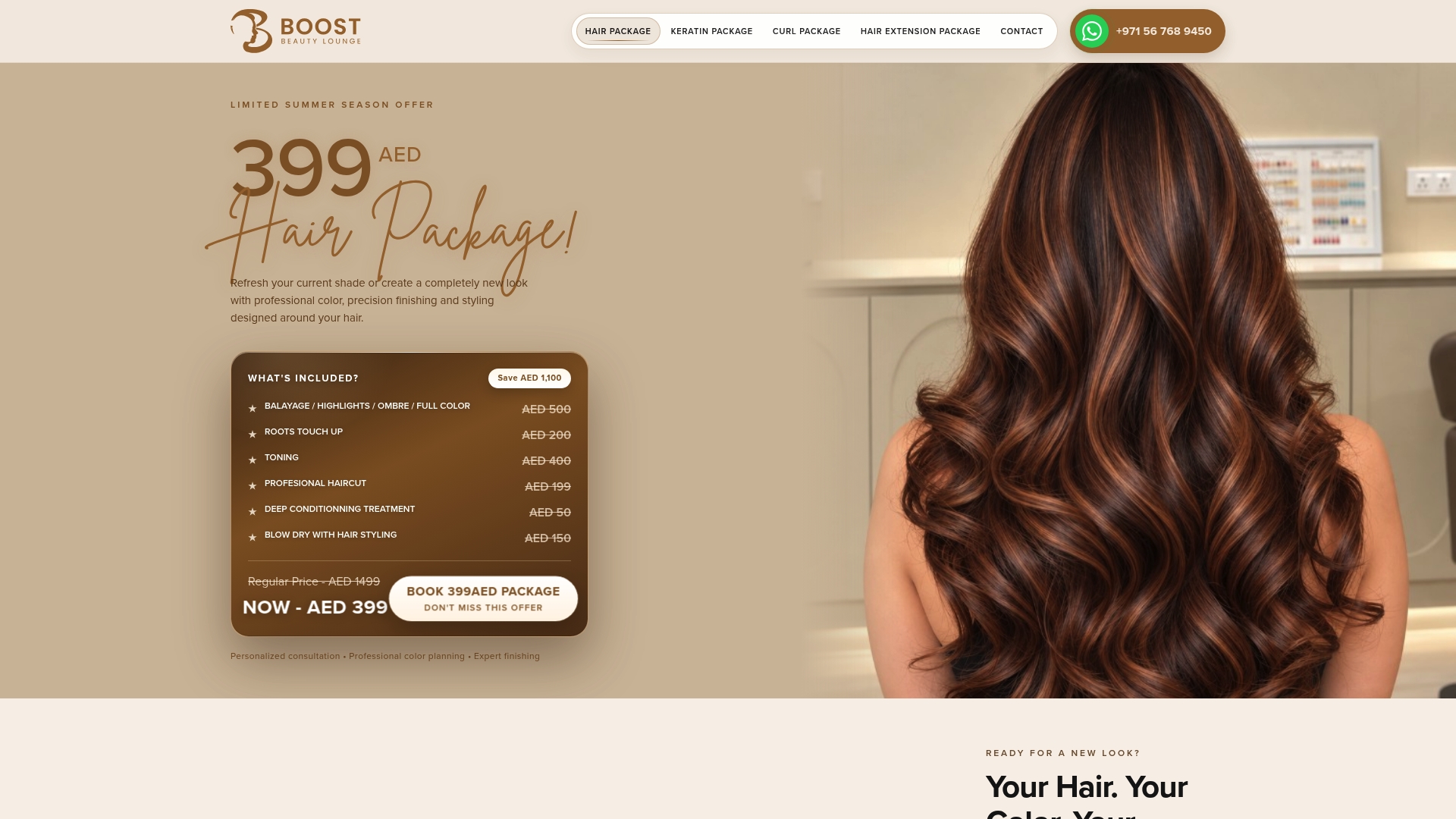
We build every colour service around a conversation first, not a formula pulled off a shelf. Our Hair Package is priced at a fixed 1,499 AED and includes roots touch-up, toning, haircut, conditioning, blow-dry and styling alongside your balayage, highlights, ombre or full colour, planned around your hair history at consultation rather than guesswork.
If you have ever reacted to hair dye, please get medical advice and clinical patch testing first. Once you are cleared to proceed, we are glad to talk through your colour plan, your allergy test results and what suits your hair during a consultation. We also offer fixed-price Keratin/Protein/Botox and Hair Extension packages for those looking beyond colour. Message us on WhatsApp or call to book a time that works for you.
Salons that want to manage bookings and showcase their own before-and-afters online can look at purpose-built options like website platforms for hairdressers and salons, which offer salon-specific booking and catalogue tools.
This article is general information, not a substitute for advice from a qualified doctor. Consult a qualified healthcare professional about your own circumstances before acting on anything here.
FAQ
How do you test for hair dye allergy?
The standard home method is an open or Allergy Alert test: apply a small mixed amount of the exact dye to your inner elbow or behind your ear, leave it uncovered, and check at 30 minutes, 24 hours and 48 hours as manufacturer instructions describe. If you have reacted before, a dermatologist can run a clinical patch test instead.
What are the signs of a hair dye allergy?
Signs include itching, redness, swelling or small blisters at the test site or along the hairline, usually appearing within 24 to 48 hours of contact. Severe reactions can involve facial swelling or breathing difficulty, which need immediate medical attention.
Can I do a skin test for hair dye allergies?
Yes, a home open test on your inner elbow or behind your ear is the standard first step before every application. It reduces risk but is not as reliable as clinical patch testing, which is carried out under medical supervision as described by the NHS guidance on hair dye reactions.
Which hair colour does not cause allergies?
No hair dye can be guaranteed allergy-free, since even PPD-free or semi-permanent alternatives carry some risk of cross-reactivity. Any alternative product should still be patch tested before full use, particularly if you have reacted to PPD before.
Sources
Ready to book this look?
See this package